Application
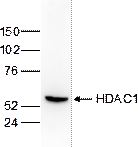
WB analysis of nuclear extracts from HeLa cells (40 μg) using HDAC1 antibody at a dilution of 1:1,000 in TBS-Tween containing 5% skimmed milk.Application
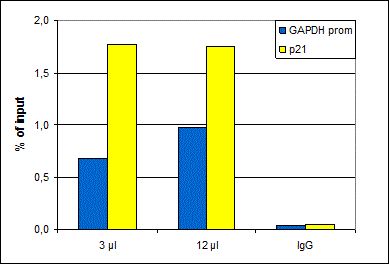
ChIP was performed with HeLa extracts and either control IgG (1 μg) or HDAC1 antibody (3 and 12 μl per ChIP experiment). The precipitated DNA was detected by qPCR with primers targeting to GAPDH promoter and the coding region of p21.| Product Name | HDAC1 antibody [GT9078] |
|---|---|
| Antibody Type | Primary Antibodies |
| Product description | Mouse monoclonal antibody [GT9078] to HDAC1Histone acetylation and deacetylation, catalyzed by multisubunit complexes, play a key role in the regulation of eukaryotic gene expression. The protein encoded by this gene belongs to the histone deacetylase/acuc/apha family and is a component of the histone deacetylase complex. It also interacts with retinoblastoma tumor-suppressor protein and this complex is a key element in the control of cell proliferation and differentiation. Together with metastasis-associated protein-2, it deacetylates p53 and modulates its effect on cell growth and apoptosis. [provided by RefSeq, Jul 2008] |
| Immunogen | Monoclonal antibody raised in mouse against human HDAC1 (Histone deacetylase 1), using a KLH-conjugated synthetic peptide containing a sequence from the C-terminal region of the protein. |
| Clonality | Monoclonal |
|---|---|
| Clone Number | GT9078 |
| Host Species | Mouse |
| Tested Applications | WBChIP |
| ChIP (3 μl/IP), Western blotting (1:1,000) | |
| Species Reactivity | Human |
| Concentration | 1mg/ml |
| Purification | Affinity purified |
| Gene Synonyms | GON-10 , HD1 , RPD3 , histone deacetylase 1 , RPD3L1 |
|---|---|
| Target | HDAC1 |
Application
WB analysis of nuclear extracts from HeLa cells (40 μg) using HDAC1 antibody at a dilution of 1:1,000 in TBS-Tween containing 5% skimmed milk.
Application
ChIP was performed with HeLa extracts and either control IgG (1 μg) or HDAC1 antibody (3 and 12 μl per ChIP experiment). The precipitated DNA was detected by qPCR with primers targeting to GAPDH promoter and the coding region of p21.| Application Notes | ChIP (3 μl/IP), Western blotting (1:1,000) |
|---|
| Form | Liquid |
|---|---|
| Storage Instructions | Store at -20°C; for long storage, store at -80°C. Avoid multiple freeze-thaw cycles. |
| Storage Buffer | Cell culture containing 0.05% azide. |


