Application
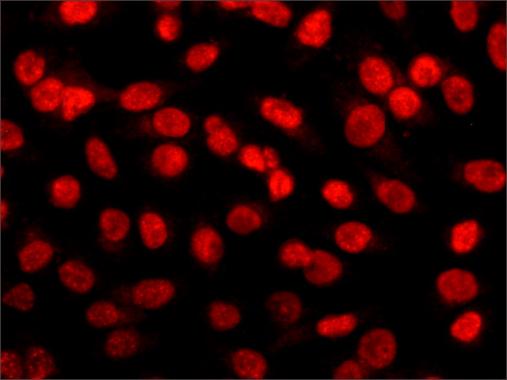
HeLa cells were fixed and permeabilized with cold methanol followed by cold methanol:acetone Fixed cells were stained with 10 μg/mL Monoclonal Anti-Histone Deacetylase 2 Clone: HDAC2-62 . The antibody was developed using Goat Anti-Mouse IgG, Cy3 conjugate.Application
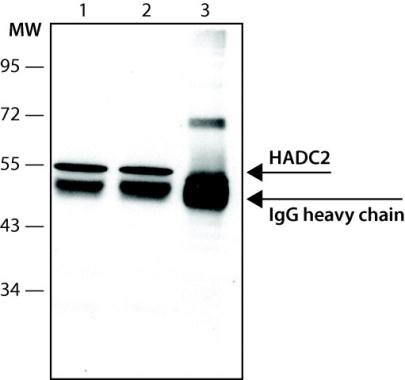
Monoclonal Anti-HDAC2 Clone: HDAC2-62 was used to immunoprecipitate HDAC2 from HeLa whole cells extract. Detection antibody: Rabbit Anti-HDAC2. Lanes 1. 5 μg antibody 2. 2.5 μg antibody 3. Negative control: 5 μg/mL non-relevant antibodyApplication
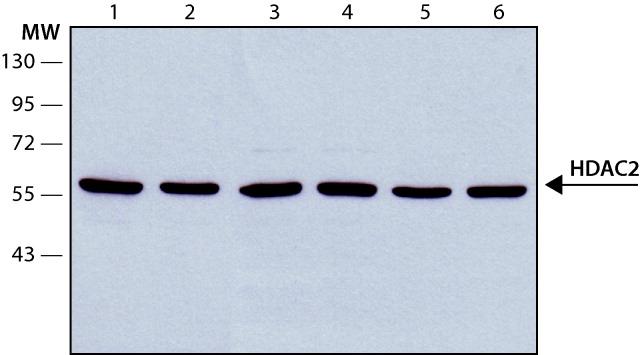
Cell line lysates were separated on SDS-PAGE and probed with 0.5 μg/mL Monoclonal Anti-Histone Deacetylase 2 Clone: HDAC2-62 . The antibody was developed using Goat Anti-Mouse IgG-Peroxidase and a chemiluminescent substrate Lanes 1. HEK-293T 2. HeLa 3. JURKAT 4. K562 5. Neuro-2a 6. NIH-3T3| Product Name | HDAC2 antibody [HDAC2-62] |
|---|---|
| Antibody Type | Primary Antibodies |
| Product description | Mouse monoclonal [HDAC2 - 62] to HDAC2The basic repeating unit of chromatin is the nucleosome, which is composed of a protein octamer containing two each of the core histones H2A, H2B, H3, and H4, surrounded by approximately 146 base pairs of DNA. Reversible acetylation of highly conserved lysine residues in the N-terminal tail domains of core histones plays an important role in transcriptional regulation, cell cycle progression, and development events. Several histone acetyltransferases (HATs) catalyze this acetylation reaction (e.g. GCN5, PCAF, p300/CBP, TAFII250, P/CAF, SRC-1, BRCA-2). Acetylation of the core histones is generally considered to be associated with gene activation, probably through maintenance of the unfolded structure of transcribing nucleosomes. Histone acetylation is a dynamic process in which levels are determined by the net activities of HATs and the competing enzymes histone deacetylases (HDACs). Both activities are associated with the nuclear matrix. Eleven different mammalian HDACs have been described. HDACs 1-3 & 8 (Class I) are similar to yeast Rpd3 protein, while HDACs 4-7, 9 & 10 (Class II) are similar to yeast Hda1 protein. The activities of the histone deacetylases are often, but not always, associated with transcriptional repression and nucleosome condensation. HDAC1, HDAC2 and several others are the catalytic subunits of different multiprotein regulatory complexes. Other components of such complexes may include: corepressors such as mSin3, N-CoR, SMRT, associated proteins such as SAP18, SAP30, RbAp46, RbAp48, and c-Ski oncogenic protein (involved in DNA methylation). Nucleosome remodeling and deacetylation (NRD) complexes containing HDAC1, HDAC2, Mi-2 (CH3, CH4) dermatomyositis specific autoantigen, and MAT2 (metastasis-associated protein) (related to MAT1) have been described. It is therefore assumed that ATP-dependent nucleosome remodeling activity and histone deacetylation may be interconnected or interdependent. Recruitment of the multiprotein complexes to promoter sites occurs by many sequence specific DNA-binding proteins such as unliganded nuclear hormone receptors, DP1-E2F, YY1, and Rb family of transcription factors, transcriptional repressors, and tumor suppressors (e.g. BRCA1). Aberrant recruitment of HDACs by various oncoproteins may occur in certain neoplastic diseases. It has been found that inhibition ofHDAC2 activity by valporic acid induces proteosomal degradation of HDAC2. |
| Immunogen | Synthetic peptide: SGEKTDTKGTKSEQLSNP with N-terminally added Cysteine conjugated to KLH, corresponding to amino acids 471-488 of Human HDAC2. |
| Clonality | Monoclonal |
|---|---|
| Isotype | IgG2 |
| Clone Number | HDAC2-62 |
| Host Species | Mouse |
| Tested Applications | ELISAICC/IFIHCIPWB |
| ELISA: Use at an assay dependent dilution. IHC: Use at an assay dependent dilution. IP: Use at an assay dependent dilution. WB: Use at a concentration of 0.25 - 0.5 μg/ml. Detects a band of approximately 55 kDa. Optimal dilutions/concentrations should be determined by the end user. | |
| Species Reactivity | HumanMouseDogRatBovine |
| Concentration | 1mg/ml |
| Purification | Protein A |
| Gene Synonyms | 605164, YAF1, RPD3, Q92769, HDAC2, 3066 |
|---|---|
| Target | HDAC2 |
| Cellular Localization | Nuclear |
Application
HeLa cells were fixed and permeabilized with cold methanol followed by cold methanol:acetone Fixed cells were stained with 10 μg/mL Monoclonal Anti-Histone Deacetylase 2 Clone: HDAC2-62 . The antibody was developed using Goat Anti-Mouse IgG, Cy3 conjugate.
Application
Monoclonal Anti-HDAC2 Clone: HDAC2-62 was used to immunoprecipitate HDAC2 from HeLa whole cells extract. Detection antibody: Rabbit Anti-HDAC2. Lanes 1. 5 μg antibody 2. 2.5 μg antibody 3. Negative control: 5 μg/mL non-relevant antibody
Application
Cell line lysates were separated on SDS-PAGE and probed with 0.5 μg/mL Monoclonal Anti-Histone Deacetylase 2 Clone: HDAC2-62 . The antibody was developed using Goat Anti-Mouse IgG-Peroxidase and a chemiluminescent substrate Lanes 1. HEK-293T 2. HeLa 3. JURKAT 4. K562 5. Neuro-2a 6. NIH-3T3| Positive Control | Whole cell extracts from NIH-3T3 cells. |
|---|---|
| Application Notes | ELISA: Use at an assay dependent dilution. IHC: Use at an assay dependent dilution. IP: Use at an assay dependent dilution. WB: Use at a concentration of 0.25 - 0.5 μg/ml. Detects a band of approximately 55 kDa. Optimal dilutions/concentrations should be determined by the end user. |
| Form | Liquid |
|---|---|
| Storage Instructions | Aliquot and store at -20°C or -80°C. Avoid repeated freeze / thaw cycles. |
| Storage Buffer | Preservative: 15mM Sodium Azide; Constituents: 0.01M PBS. pH 7.4 |


