Application
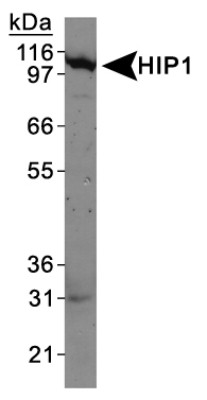
Western Blot: HIP1 Antibody (1B11) - HeLa whole cell extracts.| Product Name | HIP1 antibody |
|---|---|
| Antibody Type | Primary Antibodies |
| Product description | Mouse monoclonal [1B11] to HIP1Huntingtin disease, a neurodegenerate disease, is caused by the expansion of a polymorphic glutamine tract in huntingtin. The Huntingtin Interacting Protein 1 (HIP-1) is a proapoptotic, cargo-specific adaptor protein that may be involved in the pathogenesis of Huntingtin disease. As well as playing a role in Huntingtin disease, it is likely to be involved in the recruitment of clathrin coats to lipid membranes and it may also factor in tumorigenesis by allowing the survival of precancerous and cancerous cells. Since HIP-1 expression is significantly associated with prostate and colon cancer metastasis, HIP-1 can serve as a putative prognostic factor for prostate and colon cancers. |
| Immunogen | Human 3'-HIP1 (~65 kDa) |
| Clonality | Monoclonal |
|---|---|
| Isotype | IgG1 |
| Clone Number | 1B11 |
| Host Species | Mouse |
| Tested Applications | WB |
| For WB: Use at a dilution of 1:10,000. By Western blot, this antibody recognizes a band at ~115 kDa, representing HIP1 protein. Optimal dilutions/concentrations should be determined by the researcher.: |
|
| Species Reactivity | Human |
| Concentration | 1mg/ml |
| Purification | Affinity purified |
| Gene Synonyms | ILWEQ MGC126506 |
|---|---|
| Target | HIP1 |
| Tissue Specificity | This antibody is specific for human HIP 1. It does not cross-react with HIP 1R. |
| Cellular Localization | Cytoplasmic |
| Light Chain Type | kappa |
Application
Western Blot: HIP1 Antibody (1B11) - HeLa whole cell extracts.| Positive Control | HeLa whole cell lysate |
|---|---|
| Application Notes | For WB: Use at a dilution of 1:10,000. By Western blot, this antibody recognizes a band at ~115 kDa, representing HIP1 protein. Optimal dilutions/concentrations should be determined by the researcher.: |
| Form | Liquid |
|---|---|
| Storage Instructions | Keep as concentrated solution. Store at 4ºC short term. For extended storage aliquot and store at -20ºC or below. Avoid freeze-thaw cycles. |
| Storage Buffer | Phosphate-buffered saline containing 0.1% sodium azide. |


