Application
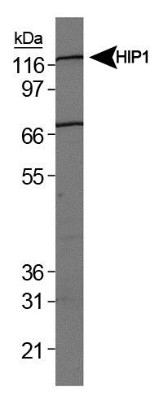
Western Blot: HIP1 Related Antibody (1E1) [ - Analysis of HIP1 on HeLa whole cell extract.| Product Name | HIP1 antibody |
|---|---|
| Antibody Type | Primary Antibodies |
| Product description | Mouse monoclonal antibody to HIP1(clone 1E1)Huntingtin disease, a neurodegenerate disease, is caused by the expansion of a polymorphic glutamine tract in huntingtin. The Huntingtin Interacting Protein 1 (HIP-1) is a reportedly proapoptotic, cargo-specific adaptor protein that may be involved in the pathogenesis of Huntingtin disease. As well as playing a role in Huntingtin disease, it is likely to be involved in the recruitment of clathrin coats to lipid membranes and it may also factor in tumorigenesis by allowing the survival of precancerous and cancerous cells. Since HIP-1 expression is significantly associated with prostate and colon cancer metastasis, HIP-1 can serve as a putative prognostic factor for prostate and colon cancers. |
| Immunogen | Human HIP1r-TALIN Homology Region (57 kDa). |
| Clonality | Monoclonal |
|---|---|
| Isotype | IgG1 |
| Clone Number | 1E1 |
| Host Species | Mouse |
| Tested Applications | WB |
| By Western blot, this antibody recognizes a band at ~120 kDa, representing HIP1 protein. One lower molecular weight band may be seen. Suggested working dilutions: *Western Blot - 1:1,000 (ECL)Immunofluorescence - NDImmunohistochemistry - NDImmunoprecipitation - ND*The investigator should determine the optimal working dilution for a specific application.: |
|
| Species Reactivity | HumanRat |
| Concentration | 1mg/ml |
| Gene Synonyms | HIP1 3092 MGC126506 ILWEQ O00291 176807 |
|---|---|
| Target | HIP1 |
| Tissue Specificity | is specific for human HIP1r. |
| Cellular Localization | Cytoplasmic |
Application
Western Blot: HIP1 Related Antibody (1E1) [ - Analysis of HIP1 on HeLa whole cell extract.| Positive Control | HeLa whole cell lysate and rat brain homogenate |
|---|---|
| Application Notes | By Western blot, this antibody recognizes a band at ~120 kDa, representing HIP1 protein. One lower molecular weight band may be seen. Suggested working dilutions: *Western Blot - 1:1,000 (ECL)Immunofluorescence - NDImmunohistochemistry - NDImmunoprecipitation - ND*The investigator should determine the optimal working dilution for a specific application.: |
| Form | Liquid |
|---|---|
| Storage Instructions | Store at ñ20 degrees Celcius. Avoid repeated freeze-thaw cycles. |
| Storage Buffer | 0.1 ml of mouse ascites (7.7 mg/ml) in PBS and 0.1% Sodium Azide. |


