Application
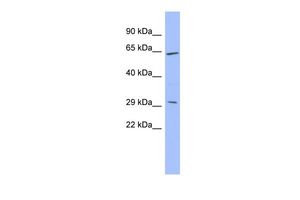
WB analysis of human fetal thymus tissue using HRG antibody at 0.2-1μg/ml.| Product Name | HRG antibody, Internal |
|---|---|
| Antibody Type | Primary Antibodies |
| Product description | Rabbit Polyclonal antibody to HRGThis histidine-rich glycoprotein contains two cystatin-like domains and is located in plasma and platelets. The physiological function has not been determined but it is known that the protein binds heme, dyes and divalent metal ions. The encoded protein also has a peptide that displays antimicrobial activity against C. albicans, E. coli, S. aureus, P. aeruginosa, and E. faecalis. It can inhibit rosette formation and interacts with heparin, thrombospondin and plasminogen. Two of the protein's effects, the inhibition of fibrinolysis and the reduction of inhibition of coagulation, indicate a potential prothrombotic effect. Mutations in this gene lead to thrombophilia due to abnormal histidine-rich glycoprotein levels. [provided by RefSeq, Nov 2014] |
| Immunogen | A synthetic peptide corresponding to an Internal region of Human HRG |
| Clonality | Polyclonal |
|---|---|
| Isotype | IgG |
| Host Species | Rabbit |
| Tested Applications | WB |
| *Optimal dilutions/concentrations should be determined by the researcher.
: |
|
| Species Reactivity | Human |
| Predicted Reactivity | Human: 100% |
| Concentration | 1mg/ml |
| Purification | Affinity purified |
| Gene Synonyms | HPRG HRG THPH11 HRGP |
|---|---|
| Target | HRG |
| Molecular Weight(MW) | 60 KDa (note) |
Application
WB analysis of human fetal thymus tissue using HRG antibody at 0.2-1μg/ml.| Positive Control | human fetal thymus |
|---|---|
| Application Notes | *Optimal dilutions/concentrations should be determined by the researcher.
: |
| Form | Liquid |
|---|---|
| Storage Instructions | Keep as concentrated solution. For short-term storage, store at 4ºC. For long-term storage, aliquot and store at -20ºC or below. Avoid multiple freeze-thaw cycles. |
| Storage Buffer | 1x PBS buffer with 0.09% (w/v) sodium azide and 2% sucrose. |


