Application
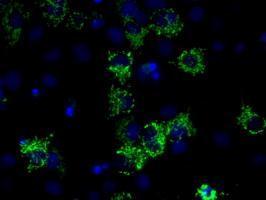
Anti-IDH3A mouse monoclonal antibody immunofluorescent staining of COS7 cells transiently transfected with IDH3AApplication
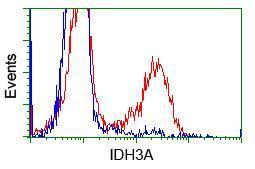
HEK293T cells transfected with either pCMV6-ENTRY IDH3A| Product Name | IDH3A antibody [2E9] |
|---|---|
| Antibody Type | Primary Antibodies |
| Product description | Mouse monoclonal antibody [2E9] to IDH3AIsocitrate dehydrogenases catalyze the oxidative decarboxylation of isocitrate to 2-oxoglutarate. These enzymes belong to two distinct subclasses, one of which utilizes NAD(+) as the electron acceptor and the other NADP(+). Five isocitrate dehydrogenases have been reported: three NAD(+)-dependent isocitrate dehydrogenases, which localize to the mitochondrial matrix, and two NADP(+)-dependent isocitrate dehydrogenases, one of which is mitochondrial and the other predominantly cytosolic. NAD(+)-dependent isocitrate dehydrogenases catalyze the allosterically regulated rate-limiting step of the tricarboxylic acid cycle. Each isozyme is a heterotetramer that is composed of two alpha subunits, one beta subunit, and one gamma subunit. The protein encoded by this gene is the alpha subunit of one isozyme of NAD(+)-dependent isocitrate dehydrogenase. [provided by RefSeq] |
| Immunogen | Full length human recombinant protein of human IDH3A (NP_005521) produced in HEK293T cell. |
| Clonality | Monoclonal |
|---|---|
| Isotype | IgG1 |
| Clone Number | 2E9 |
| Host Species | Mouse |
| Tested Applications | FACS,ICC/IF |
| Flow 1:100 | |
| Species Reactivity | Human |
| Concentration | 1mg/ml |
| Purification | Affinity purified |
| Target | IDH3A |
|---|---|
| Tissue Specificity | is specific for human IDH3A (NP_005521). |
Application
Anti-IDH3A mouse monoclonal antibody immunofluorescent staining of COS7 cells transiently transfected with IDH3A
Application
HEK293T cells transfected with either pCMV6-ENTRY IDH3A| Application Notes | Flow 1:100 |
|---|
| Form | Liquid |
|---|---|
| Storage Instructions | For short-term storage, store at 4°C or aliquot into working amounts and store at -20°C. For long-term storage, store at -70°C (aliquotted). Avoid repeated freeze-thaw cycles. |
| Storage Buffer | PBS (PH 7.3) containing 1% BSA, 50% glycerol and 0.02% sodium azide. |


