Application
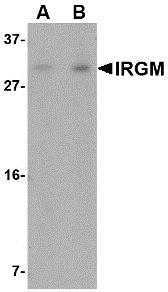
Western blot analysis of IRGM in Rat brain lysate with IRGM antibody at (A) 1 and (B) 2 ug/ml.| Product Name | IRGM antibody |
|---|---|
| Antibody Type | Primary Antibodies |
| Product description | Rabbit polyclonal antibody to IRGMAutophagy, the process of bulk degradation of cellular proteins through an autophagosomic-lysosomal pathway is important for normal growth control and may be defective in tumor cells. It is involved in the preservation of cellular nutrients under starvation conditions as well as the normal turnover of cytosolic components. Two of the strongest hits implicate genes IRGM and ATG16L1, which encode proteins thought to be critical to the autophagy pathway and being significantly associated with Crohn’s disease. In mouse, IRGM belongs to a family of gamma-interferon-induced GTP-binding proteins of approximately 48 kDa. Murine IRGM induces autophagy and generates large autolysosomal organelles as a mechanism for the elimination of intracellular Mycobacterium tuberculosis. Human IRGM is also involved in autophagy and plays a role in the control of intracellular pathogens and in the reduction of intracellular bacillary load. |
| Immunogen | A synthetic peptide corresponding to 17 amino acids near the amino terminus of the human IRGM |
| Clonality | Polyclonal |
|---|---|
| Host Species | Rabbit |
| Tested Applications | ELISAWB |
| WB:1:500~1:2000 Notes:Optimal dilutions/concentrations should be determined by the researcher. |
|
| Species Reactivity | HumanMouseRat |
| Concentration | 1mg/ml |
| Purification | Affinity purified |
| Gene Synonyms | LRG-47 IFL1 Immunity related GTPase family IRGM1 LRG47 IRGM LRG 47 |
|---|---|
| Target | IRGM |
| Tissue Specificity | This antibody is specific for IRGM |
Application
Western blot analysis of IRGM in Rat brain lysate with IRGM antibody at (A) 1 and (B) 2 ug/ml.| Positive Control | Blocking Peptide: Cat.No. GTX85039-PEP - IRGM Peptide Lysates: Cat. No. GTX27942 - Rat Brain Tissue Lysate |
|---|---|
| Application Notes | WB:1:500~1:2000 Notes:Optimal dilutions/concentrations should be determined by the researcher. |
| Form | Liquid |
|---|---|
| Storage Instructions | Keep as concentrated solution. Aliquot and store at -20ºC or below. Avoid multiple freeze-thaw cycles. |
| Storage Buffer | Antibody is supplied in PBS containing 0.02% sodium azide |


