Application
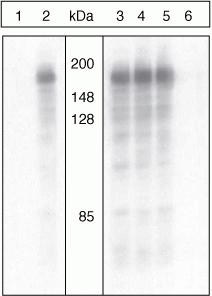
Extracts of CHO-T cells transiently transfected with wild-type human IRS-1 and treated with 100 ng/mL TPA for 30 minutes were resolved by SDS-PAGE on a 10% Tris-glycine gel and transferred to PVDF. The membrane was blocked with a 5% BSA-TBST buffer overnight at 4°C and either left untreated (2-6) or treated with lambda phosphatase (1), then incubated with the IRS-1 [pS312] antibody for two hours at room temperature in a 3% BSA-TBST buffer, following prior incubation with: no peptide (1-3), the non-phosphopeptide corresponding to the phosphopeptide immunogen (4), a generic phosphoserine-containing peptide (5), or the phosphopeptide immunogen (6). After washing, the membrane was incubated with goat F(ab)2 anti-rabbit IgG alkaline phosphatase and signals were detected. The data show that only the phosphopeptide corresponding to IRS-1 [pS312] blocks the antibody signal, demonstrating the specificity of the antibody. The data also show that phosphatase stripping eliminates the signal, verifying that the antibody is phospho-specific| Product Name | IRS1 (phospho Ser312) antibody |
|---|---|
| Antibody Type | Primary Antibodies |
| Product description | Rabbit polyclonal to IRS1 ( phospho S312 )Insulin Receptor Substrate 1 (IRS 1) is an 165 kDa multi-phosphorylated cytoplasmic docking protein involved in metabolic and proliferative signalling by insulin, IL-4, and other cytokines. IRS 1 functions to enhance growth hormone-induced proliferative signaling. The activated insulin receptor phosphorylates IRS proteins on multiple tyrosine residues that serve as docking sites for downstream mediators of metabolic actions such as phosphatidylinositol-3 kinase. IRS proteins also undergo serine phosphorylation, which regulates its function. Phosphorylation of human IRS 1 at serines 312 and 616 (serines 307 and 612 in mouse) results in the impairment of metabolic insulin signalling pathways. |
| Immunogen | Synthetic peptide (Human) derived from a region of IRS 1 that contains serine 312. |
| Modification | p-Ser312 |
| Clonality | Polyclonal |
|---|---|
| Isotype | IgG |
| Host Species | Rabbit |
| Tested Applications | WB |
| WB: Use at a concentration of 0.35 - 1.0 μg/ml. Predicted molecular weight: 165 kDa. Optimal dilutions/concentrations should be determined by the end user.: |
|
| Species Reactivity | HumanMouseRat |
| Concentration | 1mg/ml |
| Purification | Affinity purified |
| Gene Synonyms | HIRS-1 HIRS 1 HIRS1 IRS1 (phospho S312) IRS1 (phospho Ser312) IRS1 (pS312) IRS1 (pSer312) IRS1 phospho S312 IRS1 phospho Ser312 Phospho IRS1 (S312) Phospho IRS1 (Ser312) Phospho IRS1 (pS312) Phospho IRS1 (pSer312) |
|---|---|
| Target | IRS1 |
Application
Extracts of CHO-T cells transiently transfected with wild-type human IRS-1 and treated with 100 ng/mL TPA for 30 minutes were resolved by SDS-PAGE on a 10% Tris-glycine gel and transferred to PVDF. The membrane was blocked with a 5% BSA-TBST buffer overnight at 4°C and either left untreated (2-6) or treated with lambda phosphatase (1), then incubated with the IRS-1 [pS312] antibody for two hours at room temperature in a 3% BSA-TBST buffer, following prior incubation with: no peptide (1-3), the non-phosphopeptide corresponding to the phosphopeptide immunogen (4), a generic phosphoserine-containing peptide (5), or the phosphopeptide immunogen (6). After washing, the membrane was incubated with goat F(ab)2 anti-rabbit IgG alkaline phosphatase and signals were detected. The data show that only the phosphopeptide corresponding to IRS-1 [pS312] blocks the antibody signal, demonstrating the specificity of the antibody. The data also show that phosphatase stripping eliminates the signal, verifying that the antibody is phospho-specific| Positive Control | Phorbol ester stimulated (TPA) Chinese Hamster Ovary cell line expressing human insulin receptor (CHO-T) and transiently transfected with a plasmid encoding human IRS 1 |
|---|---|
| Application Notes | WB: Use at a concentration of 0.35 - 1.0 μg/ml. Predicted molecular weight: 165 kDa. Optimal dilutions/concentrations should be determined by the end user.: |
| Form | Liquid |
|---|---|
| Storage Instructions | Aliquot and store at -20°C or -80°C. Avoid repeated freeze / thaw cycles. |
| Storage Buffer | Preservative: 0.05% Sodium Azide; Constituents: PBS, 50% glycerol, 1mg/ml BSA (IgG, protease free). pH 7.3 |


