Application
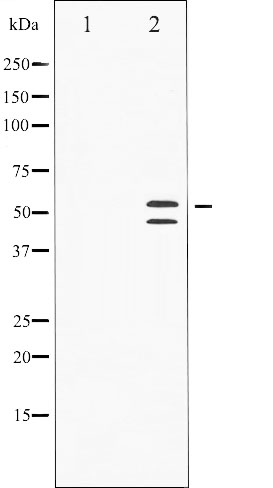
Western blot analysis of SAPK/JNK phosphorylation expression in Anisomycin treated HeLa whole cell lysates,The lane on the left is treated with the antigen-specific peptide.| Product Name | JNK (phospho Thr183) antibody |
|---|---|
| Antibody Type | Primary Antibodies |
| Product description | Rabbit Polyclonal antibody to JNK (phospho Thr183)The protein encoded by this gene is a member of the MAP kinase family. MAP kinases act as an integration point for multiple biochemical signals, and are involved in a wide variety of cellular processes such as proliferation, differentiation, transcription regulation and development. This kinase is activated by various cell stimuli, and targets specific transcription factors, and thus mediates immediate-early gene expression in response to cell stimuli. The activation of this kinase by tumor-necrosis factor alpha (TNF-alpha) is found to be required for TNF-alpha induced apoptosis. This kinase is also involved in UV radiation induced apoptosis, which is thought to be related to cytochrom c-mediated cell death pathway. Studies of the mouse counterpart of this gene suggested that this kinase play a key role in T cell proliferation, apoptosis and differentiation. Four alternatively spliced transcript variants encoding distinct isoforms have been reported. [provided by RefSeq, Jul 2008] |
| Immunogen | A synthesized peptide derived from human SAPK/JNK around the phosphorylation site of Thr183 |
| Modification | p-Thr183 |
| Clonality | Polyclonal |
|---|---|
| Isotype | IgG |
| Host Species | Rabbit |
| Tested Applications | IHCWB |
| WB 1:500-1:2000, IHC 1:50-1:200: |
|
| Species Reactivity | HumanMouseRat |
| Concentration | 1mg/ml (Please refer to the vial label for the specific concentration) |
| Purification | Affinity purified |
| Gene Synonyms | SAPK/JNK (phospho Thr183) (phospho Thr183) Phospho SAPK/JNK (phospho Thr183) Thr183 Phospho Thr183 SAPK/JNK (phospho Thr183) Phospho SAPK/JNK (phospho Thr183) PRKM8 JNK-46 phospho SAPK/JNK (phosp |
|---|---|
| Target | JNK (phospho Thr183) |
| Tissue Specificity | MAPK8 |
Application
Western blot analysis of SAPK/JNK phosphorylation expression in Anisomycin treated HeLa whole cell lysates,The lane on the left is treated with the antigen-specific peptide.| Application Notes | WB 1:500-1:2000, IHC 1:50-1:200: |
|---|
| Form | Liquid |
|---|---|
| Storage Instructions | Keep as concentrated solution. Aliquot and store at -20ºC or below. Avoid multiple freeze-thaw cycles. |
| Storage Buffer | phosphate buffered saline , pH 7.4, 150mM NaCl, 0.02% sodium azide and 50% glycerol. |


