Application
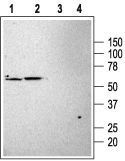
WB analysis of rat brain (lanes 1 and 3) and pancreas (lanes 2 and 4) membranes using K2P3.1 / TASK1 antibody at a dilution of 1:200 in the absence (lanes 1 and 2) or presence (lanes 3 and 4) of blocking peptide.| Product Name | K2P3.1 / TASK1 antibody |
|---|---|
| Antibody Type | Primary Antibodies |
| Product description | Rabbit Polyclonal antibody to K2P3.1 / TASK1This gene encodes a member of the superfamily of potassium channel proteins that contain two pore-forming P domains. The encoded protein is an outwardly rectifying channel that is sensitive to changes in extracellular pH and is inhibited by extracellular acidification. Also referred to as an acid-sensitive potassium channel, it is activated by the anesthetics halothane and isoflurane. Although three transcripts are detected in northern blots, there is currently no sequence available to confirm transcript variants for this gene. [provided by RefSeq, Aug 2008] |
| Immunogen | Peptide (C)EDEKRDAEHRALLTRNGQ, corresponding to amino acid residues 252-269 of human K2P3.1 (TASK-1) (Accession O14649). Intracellular, C-terminal part. |
| Clonality | Polyclonal |
|---|---|
| Host Species | Rabbit |
| Tested Applications | IHCIPWB |
| IHC:1:50~1:200 IP:1:100~1:500 WB:1:500~1:2000 Notes:Optimal dilutions/concentrations should be determined by the researcher. |
|
| Species Reactivity | HumanRat |
| Concentration | 1mg/ml |
| Purification | Affinity purified |
| Gene Synonyms | potassium channel subfamily K member 3 K2p3.1 TBAK1 TASK TASK-1 OAT1 KCNK3 |
|---|---|
| Target | K2P3.1 / TASK1 |
Application
WB analysis of rat brain (lanes 1 and 3) and pancreas (lanes 2 and 4) membranes using K2P3.1 / TASK1 antibody at a dilution of 1:200 in the absence (lanes 1 and 2) or presence (lanes 3 and 4) of blocking peptide.| Application Notes | IHC:1:50~1:200 IP:1:100~1:500 WB:1:500~1:2000 Notes:Optimal dilutions/concentrations should be determined by the researcher. |
|---|
| Form | Liquid |
|---|---|
| Storage Instructions | Keep as concentrated solution. Aliquot and store at -20ºC or below. Avoid multiple freeze-thaw cycles. |
| Storage Buffer | Phosphate buffered saline (PBS), pH 7.4, 1% BSA, 5% sucrose and 0.025% NaN3. |


