Application
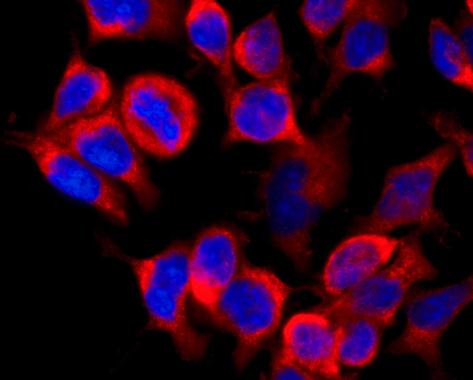
Immunofluorescence staining of vesicles (red) in RBL-2H3 rat basophilic leukemia cell line using anti-Kinesin . Nuclei were stained with DAPI (blue).| Product Name | Kinesin antibody [KN-02] |
|---|---|
| Antibody Type | Primary Antibodies |
| Product description | Mouse monoclonal [KN - 02] to KinesinKinesin belongs to the group of motor proteins known to convert chemical energy released from ATP into mechanical energy. Conventional kinesin, member of the kinesin superfamily comprising more than 100 proteins, is involved in the anterograde vesicle transport inneuronal cells. Kinesin purified from mammalian brain homogenates is a heterotetramer consisting of two heavy (120 to 130 kDa) and two light chains (60 to 70 kDa), resulting in a molecular mass about 400 kDa. Each heavy chain contains an N-terminal globular motordomain with both a microtubule-binding site and an ATPase active center, stalk region responsible for heavy chain dimerization and finally C-terminal globular tail domain, which is implicated in cargo binding. Light chains may have a regulatory function. |
| Immunogen | Enriched fraction of porcine brain kinesin. |
| Clonality | Monoclonal |
|---|---|
| Isotype | IgM |
| Clone Number | KN-02 |
| Host Species | Mouse |
| Tested Applications | ICC/IF |
| ICC: Use at an assay dependent dilution. Optimal dilutions/concentrations should be determined by the end user. | |
| Species Reactivity | HumanMousePigRat |
| Concentration | 1mg/ml (Please refer to the vial label for the specific concentration) |
| Purification | Unpurified |
| Gene Synonyms | kinesin 1 (110-120kD) kinesin family member 5B Kinesin heavy chain ubiquitous UKHC |
|---|---|
| Target | Kinesin |
| Tissue Specificity | The antibody reacts with heavy chain of conventional kinesin associated with vesicles and with lower affinity with denaturated molecule. The antibody does not react with kinesin bound to taxol-stabilized microtubules. |
| Cellular Localization | Microtubules |
Application
Immunofluorescence staining of vesicles (red) in RBL-2H3 rat basophilic leukemia cell line using anti-Kinesin . Nuclei were stained with DAPI (blue).| Application Notes | ICC: Use at an assay dependent dilution. Optimal dilutions/concentrations should be determined by the end user. |
|---|
| Form | Liquid |
|---|---|
| Storage Instructions | For short-term storage, store at 4° C. For long-term storage, aliquot and store at -20ºC or below. Avoid multiple freeze-thaw cycles. |
| Storage Buffer | Phosphate buffered saline pH 7.4 containing 15mM sodium azide |


