Application
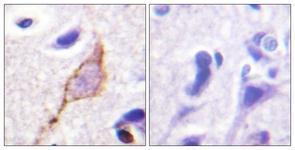
Immunohistochemistry analysis of paraffin-embedded human brain tissue, using Kv7.3/KCNQ3 Antibody. The picture on the right is treated with the synthesized peptide.| Product Name | Kv7.3/KCNQ3 antibody |
|---|---|
| Antibody Type | Primary Antibodies |
| Product description | Rabbit polyclonal antibody to Kv7.3/KCNQ3Probably important in the regulation of neuronal excitability. Associates with KCNQ2 or KCNQ5 to form a potassium channel with essentially identical properties to the channel underlying the native M-current, a slowly activating and deactivating potassium conductance which plays a critical role in determining the subthreshold electrical excitability of neurons as well as the responsiveness to synaptic inputs. |
| Immunogen | The antiserum was produced against synthesized peptide derived from human Kv7.3/KCNQ3. |
| Clonality | Polyclonal |
|---|---|
| Host Species | Rabbit |
| Tested Applications | ELISAIHCIHC-P |
| ELISA: 1:1000Optimal dilutions should be determined experimentally by the end user.: |
|
| Species Reactivity | HumanMouseRat |
| Concentration | 1mg/ml |
| Purification | Affinity purified |
| Gene Synonyms | Kv7.3/KCNQ3 voltagegated potassium channel subunit Kv7.3 potassium channel alpha subunit KvLQT3 potassium volta KQT-like 3 voltage-gated potassium channel subunit Kv7.3 potassium voltage-gated channel subfamily KQT member 3 KQTlike 3 KCNQ3 KQTlike |
|---|---|
| Target | Kv7.3/KCNQ3 |
| Molecular Weight(MW) | 96 kDa (note) |
| Tissue Specificity | Kv7.3/KCNQ3 (Ab-246) Antibody detects endogenous levels of total Kv7.3/KCNQ3 protein. |
Application
Immunohistochemistry analysis of paraffin-embedded human brain tissue, using Kv7.3/KCNQ3 Antibody. The picture on the right is treated with the synthesized peptide.| Application Notes | ELISA: 1:1000Optimal dilutions should be determined experimentally by the end user.: |
|---|
| Form | Liquid |
|---|---|
| Storage Instructions | Store at -20 degrees Celcius. Product is stable for at least 1 year. |
| Storage Buffer | Phosphate buffered saline (without Mg2+ and Ca2+), pH 7.4, 150mM NaCl, 0.02% sodium azide and 50% glycerol. |


