Application
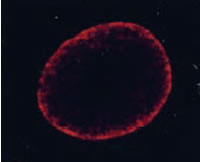
ICC/IF analysis of COS cells using Lamin B antibody [X223].Application
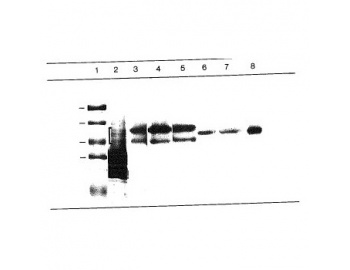
WB analysis of HT29 lysate using Lamin B antibody [X223] (lane 7).| Product Name | Lamin B antibody |
|---|---|
| Antibody Type | Primary Antibodies |
| Product description | Mouse Monoclonal antibody [X223] to Lamin BThe nuclear lamina consists of a two-dimensional matrix of proteins located next to the inner nuclear membrane. The lamin family of proteins make up the matrix and are highly conserved in evolution. During mitosis, the lamina matrix is reversibly disassembled as the lamin proteins are phosphorylated. Lamin proteins are thought to be involved in nuclear stability, chromatin structure and gene expression. Vertebrate lamins consist of two types, A and B. This gene encodes one of the two B type proteins, B1. Alternative splicing results in transcript variants and a duplication of this gene is associated with autosomal dominant adult-onset leukodystrophy (ADLD). [provided by RefSeq] |
| Immunogen | Nuclear pore complex-lamina fraction of Xenopus laevis (XLKE-A6 cells) |
| Conjugation | Agarose |
| Modification | Acetylated |
| Clonality | Monoclonal |
|---|---|
| Isotype | IgG1 |
| Clone Number | X223 |
| Host Species | Mouse |
| Tested Applications | ICC/IFWB |
| WB:1:500~1:2000 ICC/IF:1:100~1:500 |
|
| Species Reactivity | BovineHumanMouseRat |
| Concentration | 1mg/ml |
| Purification | Affinity purified |
| Gene Synonyms | Lamin-L(I) MGC52550 lamin-b lamin b Lamin L(I) laminb LaminL(I) |
|---|---|
| Target | Lamin B |
| Molecular Weight(MW) | 65 - 67 kDa (note) |
| Tissue Specificity | This antibody decorates the karyoskeleton, i.e. the intermediate filament equivalent of the nucleus. Reacts with lamin isotypes of Mr 60 -75 kD. Recognises lamin B1 & B2 in human, bovine & rat, and lamin B2 in mouse |
Application
ICC/IF analysis of COS cells using Lamin B antibody [X223].
Application
WB analysis of HT29 lysate using Lamin B antibody [X223] (lane 7).| Application Notes | WB:1:500~1:2000 ICC/IF:1:100~1:500 |
|---|
| Form | Liquid |
|---|---|
| Storage Instructions | Store at 2-8°C. For extended storage, aliquot and store at -20°C. Avoid repeated freeze-thaw cycles. |
| Storage Buffer | Tissue culture supernatant containing 0.09% sodium azide |


