Application
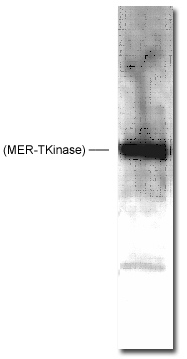
Western blot using and human RPE cells (antibody dilution 1:500).| Product Name | MERTK antibody |
|---|---|
| Antibody Type | Primary Antibodies |
| Product description | Rabbit polyclonal to MERTKIn vertebrates, the photoreceptor cells are the basic sensory apparatus of the retina primarily converting photon energy absorbed from light into neuronal signals. The photoreceptor proximal outer segments are synthesized daily by cell bodies, and outer segment tips are removed with a circadian rhythm. The shed outer segments are endocytosed by adjacent retinal pigment epithelial (RPE) cells, and are recycled to photoreceptors. The receptor tyrosine kinase MERTK protein is a approximately 120-122 kDa (994 amino acids) protein expressed in RPEs. MERTK has a tyrosine kinase domain closer to the C-terminal region and putative phosphorylation sites. Mutation of MERTK in the Royal College of Surgeons (RCS) rat results in defective phagocytosis of photoreceptor outer segments by the retinal pigment epithelium (RPE) and retinal degeneration resulting in retinitis pigmentosa. |
| Immunogen | Synthetic peptide (Human). |
| Clonality | Polyclonal |
|---|---|
| Isotype | IgG |
| Host Species | Rabbit |
| Tested Applications | ICC/IFIPWB |
| ICC: Use at an assay dependent dilution. IP: Use at a dilution of 1/200. WB: Use at a dilution of 1/500. Detects a band of approximately 110 kDa. Optimal dilutions/concentrations should be determined by the end user.: |
|
| Species Reactivity | Human |
| Concentration | 1mg/ml |
| Purification | Affinity purified |
| Gene Synonyms | MER MGC133349 RP38 c-mer c mer cmer |
|---|---|
| Target | MERTK |
Application
Western blot using and human RPE cells (antibody dilution 1:500).| Application Notes | ICC: Use at an assay dependent dilution. IP: Use at a dilution of 1/200. WB: Use at a dilution of 1/500. Detects a band of approximately 110 kDa. Optimal dilutions/concentrations should be determined by the end user.: |
|---|
| Form | Liquid |
|---|---|
| Storage Instructions | Keep as concentrated solution. Store at 4ºC short term. For extended storage aliquot and store at -20ºC or below. Avoid freeze-thaw cycles. |
| Storage Buffer | phosphate buffered saline , pH 7.4, 150mM NaCl, 0.02% sodium azide and 50% glycerol. |


