Application
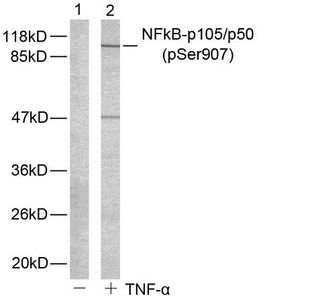
WB analysis of extract from untreated or TNFα-treated HeLa cells using NFκB p105/p50 (phospho Ser907) antibody.Application
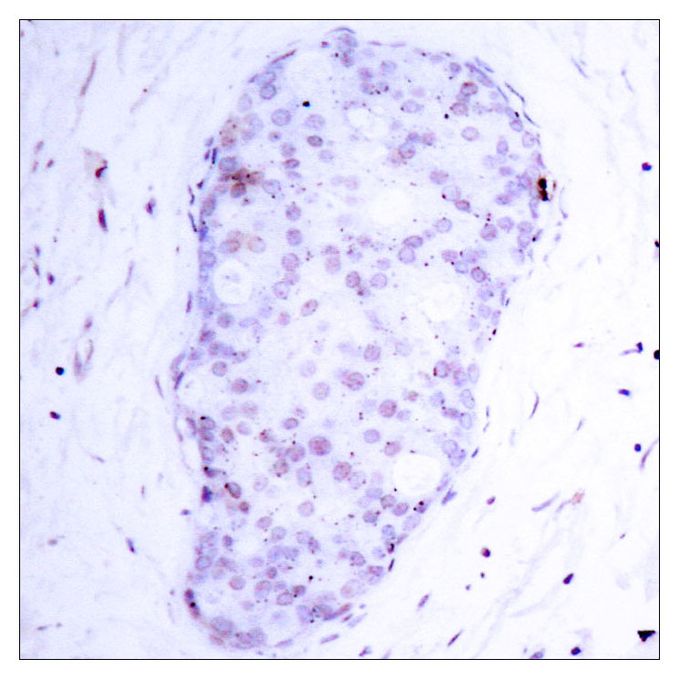
IHC-P analysis of human breast carcinoma tissue using NFκB p105/p50 (phospho Ser907) antibody.| Product Name | NFkB p105 (phospho Ser907) antibody |
|---|---|
| Antibody Type | Primary Antibodies |
| Product description | Rabbit polyclonal antibody to NFkB p105 (phospho Ser907)This gene encodes a 105 kD protein which can undergo cotranslational processing by the 26S proteasome to produce a 50 kD protein. The 105 kD protein is a Rel protein-specific transcription inhibitor and the 50 kD protein is a DNA binding subunit of the NF-kappa-B (NFKB) protein complex. NFKB is a transcription regulator that is activated by various intra- and extra-cellular stimuli such as cytokines, oxidant-free radicals, ultraviolet irradiation, and bacterial or viral products. Activated NFKB translocates into the nucleus and stimulates the expression of genes involved in a wide variety of biological functions. Inappropriate activation of NFKB has been associated with a number of inflammatory diseases while persistent inhibition of NFKB leads to inappropriate immune cell development or delayed cell growth. Two transcript variants encoding different isoforms have been found for this gene. [provided by RefSeq] |
| Modification | p-Ser907 |
| Clonality | Polyclonal |
|---|---|
| Isotype | IgG |
| Host Species | Rabbit |
| Tested Applications | IHCIHC-PWB |
| Suggested starting dilutions are as follows. WB: 1:500-1:1000,IHC: 1:50-1:100. Not yet tested in other applications. Optimal working dilutions should be determined experimentally by the end user.: |
|
| Species Reactivity | Human |
| Concentration | 1mg/ml (Please refer to the vial label for the specific concentration) |
| Purification | Affinity purified |
| Gene Synonyms | DKFZp686C01211 EBP-1 KBF1 MGC54151 NF-kappa-B NFKB-p105 NFKB-p50 |
|---|---|
| Target | NFkB p105 (phospho Ser907) |
| Cellular Localization | Nuclear, but also found in the cytoplasm in an inactive form complexed to an inhibitor. |
Application
WB analysis of extract from untreated or TNFα-treated HeLa cells using NFκB p105/p50 (phospho Ser907) antibody.
Application
IHC-P analysis of human breast carcinoma tissue using NFκB p105/p50 (phospho Ser907) antibody.| Application Notes | Suggested starting dilutions are as follows. WB: 1:500-1:1000,IHC: 1:50-1:100. Not yet tested in other applications. Optimal working dilutions should be determined experimentally by the end user.: |
|---|
| Form | Liquid |
|---|---|
| Storage Instructions | Keep as concentrated solution. Aliquot and store at -20ºC or below. Avoid multiple freeze-thaw cycles. |
| Storage Buffer | PBS (without Mg2+and Ca2+), pH 7.4, 150mM NaCl, 0.02%sodium azide and 50% glycerol. |


