Application
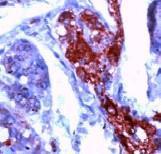
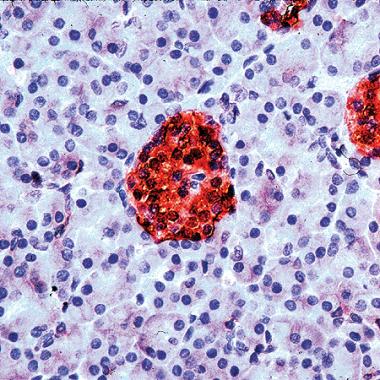
staining NSE in human pancreas by Immunohistochemistry (FFPE-sections).Application
Human Pancreas stained with anti-Neuron Specific Enolase (NSE) antibody| Product Name | NSE antibody (ready-to-use) |
|---|---|
| Antibody Type | Primary Antibodies |
| Product description | Rabbit polyclonal to NSE predilutedEnolase is a glycolytic enzyme catalyzing the reaction pathway between 2-phospho-glycerate and phosphoenol pyruvate. In mammals, enolase molecules are dimers composed of three distinct subunits (alpha, beta and gamma). The alpha subunit is expressed in most tissues and the beta subunit only in muscle. The gamma subunit is expressed primarily in neurons, in normal and in neoplastic neuroendocrine cells. Coexpression of NSE (neuron specific enolase) and chromogranin A is common in neuroendocrine neoplasms. |
| Immunogen | Synthetic peptide (unfortunately, the amino acid sequence is considered to be commercially sensitive) (Human) (C terminal). |
| Clonality | Polyclonal |
|---|---|
| Isotype | IgG |
| Host Species | Rabbit |
| Tested Applications | IHC-P |
| IHC-P: Working dilution, ready-to-use for 10 minutes at RT. Staining of formalin-fixed tissues requires boiling tissue sections in 10mM Citrate buffer, pH 6.0 for 10 minutes, followed by cooling at RT for 20 minutes. Optimal dilutions/concentrations should be determined by the end user.: |
|
| Species Reactivity | Human |
| Concentration | 1mg/ml |
| Purification | Affinity purified |
| Gene Synonyms | NSE |
|---|---|
| Target | NSE |
| Cellular Localization | Cytoplasmic |
Application
staining NSE in human pancreas by Immunohistochemistry (FFPE-sections).
Application
Human Pancreas stained with anti-Neuron Specific Enolase (NSE) antibody| Positive Control | IMR cells, Pancreas |
|---|---|
| Application Notes | IHC-P: Working dilution, ready-to-use for 10 minutes at RT. Staining of formalin-fixed tissues requires boiling tissue sections in 10mM Citrate buffer, pH 6.0 for 10 minutes, followed by cooling at RT for 20 minutes. Optimal dilutions/concentrations should be determined by the end user.: |
| Form | Liquid |
|---|---|
| Storage Instructions | Keep as concentrated solution and store at 4°C. Do not freeze. |
| Storage Buffer | PBS, pH 7.4 containing 1%BSA and 0.1% sodium azide |


