Application
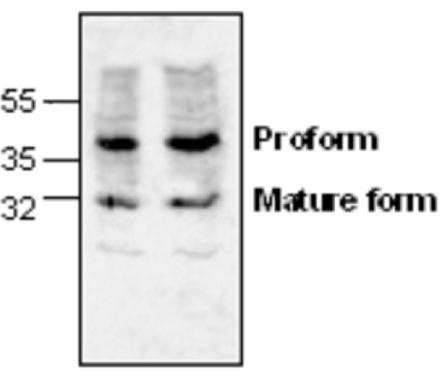
Western blot analysis of LOX-1 expression in Jurkat cell lysate.| Product Name | OLR1 / LOX-1 antibody |
|---|---|
| Antibody Type | Primary Antibodies |
| Product description | Rabbit polyclonal antibody to LOX-1Lectin-like oxidized low-density-lipoprotein receptor-1 (LOX-1), also known as oxidized low-density-lipoprotein receptor-1 (OLR-1), belongs to the C-type lectin family. LOX-1 binds and supports the internalization of multiple structurally unrelated macromolecules including oxidized LDL, advanced glycation end products (AGE), activated platelets, bacteria, apoptotic or aged cells, and heat shock proteins. Human LOX-1 gene encodes a 273 amino acid residues (aa) protein with a short N-terminal intracellular domain, a transmembrane domain, an extracellular stalk/neck region followed a C-type lectin-like domain (CTLD). The expression of LOX-1 is induced by proinflammatory or proatherogenic stimuli, as well as by oxidized LDL itself and hemodynamic or oxidative stress. LOX-1-dependent oxidized LDL uptake also induces apoptosis by inducing the expression of the pro-apoptotic Bax and downregulation of the anti-apoptotic Bcl-2. |
| Clonality | Polyclonal |
|---|---|
| Isotype | IgG |
| Host Species | Rabbit |
| Tested Applications | WB |
| Western blotting (0.5-4 µg/ml), detecting the pro- (~50 kDa) and the mature (~30 kDa) forms of Lox-1 in samples from human, mouse and rat origins. Other applications have not been determined.: |
|
| Species Reactivity | HumanMouseRat |
| Concentration | 0.5mg/ml |
| Purification | Affinity purified |
| Gene Synonyms | OLR1 STK-10 Serine/Threonine Kinase10 Lymphocyte Oriented Kinase STK10 LOK Serine/Threonine Kinase 10 LOX1 STK 10 |
|---|---|
| Target | LOX-1 |
| Tissue Specificity | This antibody is specific for LOX-1. |
| Cellular Localization | A secreted form also exists. |
Application
Western blot analysis of LOX-1 expression in Jurkat cell lysate.| Application Notes | Western blotting (0.5-4 µg/ml), detecting the pro- (~50 kDa) and the mature (~30 kDa) forms of Lox-1 in samples from human, mouse and rat origins. Other applications have not been determined.: |
|---|
| Form | Liquid |
|---|---|
| Storage Instructions | The antibody solution should be gently mixed before use. Stored at -20 °C for future use. |
| Storage Buffer | PBS (pH 7.2) containing 30% glycerol, 0.5% BSA, 0.01% thimerosal |


