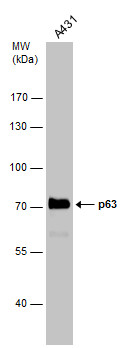
Application
Whole cell extract (30 µg) was separated by 7.5% SDS-PAGE, and the membrane was blotted with p63 antibody [GT1179] diluted at 1:2000.| Product Name | p63 antibody |
|---|---|
| Antibody Type | Primary Antibodies |
| Product description | Mouse Monoclonal antibody [GT1179] to p63 (tumor protein p63)This gene encodes a member of the p53 family of transcription factors. An animal model, p63 -/- mice, has been useful in defining the role this protein plays in the development and maintenance of stratified epithelial tissues. p63 -/- mice have several developmental defects which include the lack of limbs and other tissues, such as teeth and mammary glands, which develop as a result of interactions between mesenchyme and epithelium. Mutations in this gene are associated with ectodermal dysplasia, and cleft lip/palate syndrome 3 (EEC3); split-hand/foot malformation 4 (SHFM4); ankyloblepharon-ectodermal defects-cleft lip/palate; ADULT syndrome (acro-dermato-ungual-lacrimal-tooth); limb-mammary syndrome; Rap-Hodgkin syndrome (RHS); and orofacial cleft 8. Both alternative splicing and the use of alternative promoters results in multiple transcript variants encoding different proteins. Many transcripts encoding different proteins have been reported but the biological validity and the full-length nature of these variants have not been determined. [provided by RefSeq] |
| Immunogen | Recombinant protein encompassing a sequence within the center region of human p63. The exact sequence is proprietary. |
| Clonality | Polyclonal |
|---|---|
| Isotype | IgG1 |
| Clone Number | GT1179 |
| Host Species | Rabbit |
| Tested Applications | WB |
| *Optimal dilutions/concentrations should be determined by the researcher.
: |
|
| Species Reactivity | Human |
| Concentration | 1mg/ml (Please refer to the vial label for the specific concentration) |
| Purification | Affinity purified |
| Gene Synonyms | AIS antibody B(p51A) antibody B(p51B) antibody EEC3 antibody KET antibody LMS antibody NBP antibody OFC8 antibody RHS antibody SHFM4 antibody TP53CP antibody TP53L antibody TP63 antibody TP73L antibody p40 antibody |
|---|---|
| Target | p63 |
| Molecular Weight(MW) | 77 kDa (note) |
| Cellular Localization | Nucleus |
Application
Whole cell extract (30 µg) was separated by 7.5% SDS-PAGE, and the membrane was blotted with p63 antibody [GT1179] diluted at 1:2000.| Positive Control | A431 |
|---|---|
| Application Notes | *Optimal dilutions/concentrations should be determined by the researcher.
: |
| Form | Liquid |
|---|---|
| Storage Instructions | Keep as concentrated solution. Aliquot and store at -20ºC or below. Avoid multiple freeze-thaw cycles. |
| Storage Buffer | PBS |


