Application
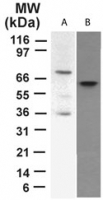
Western blot analysis of p73 in A) transfected cell lysate and B) HeLa cell lysate using at 2 ug/ml.Application
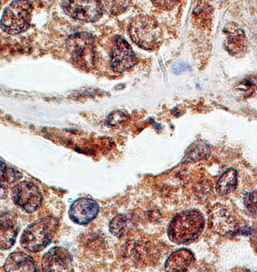
Formalin-fixed, paraffin-embedded breast cancer probed with p73 antibody at 5 ug/ml. Human tissue TMA was used for this test.| Product Name | p73 antibody |
|---|---|
| Antibody Type | Primary Antibodies |
| Product description | Mouse monoclonal antibody [5B429] to p73p73 protein is a member of the p53 family of proteins. The tumor-suppressor protein p53 exhibits sequence specific DNA-binding, directly interacts with various cellular and viral proteins, and induces cell cycle arrest in response to DNA damage. In response to signals generated by a variety of genotoxic stresses, e.g, UV irradiation or DNA damage, p53 is expressed and undergoes post-translational modification that results in its accumulation in the nucleus. Activation of p53 leads to cell cycle arrest and in some cases to apoptosis, resulting in the inability of genetically damaged cells to proliferate. Thus, the p53-dependent pathways help to maintain genomic stability by eliminating damaged cells. The accumulation of high levels of p53 is a potential marker for malignancy. p73 protein is expressed in either full-length form (p73 alpha 80 kDa) or a shorter (p73 beta 70 kDa) mRNA variant. p73 gene was predicted to encode a protein with significant amino acid sequence similarity to p53. Each of the p53 amino acid residues implicated in direct sequence-specific DNA binding is conserved in p73.p73 can activate the transcription of p53-responsive genes and inhibit cell growth in a p53-like manner by inducing apoptosis and cell cycle arrest. p73 has been mapped at chromosome 1p36.3, which is a locus of multiple suppressor genes for tumors including neuroblastoma and other cancers. c-Abl stimulates p73-mediated transactivation and apoptosis. This regulation of p73 by c-Abl in response to DNA damage was also demonstrated by a failure of ionizing radiation-induced apoptosis after disruption of c-Abl-p73 interaction. The p73 protein can activate p53-responsive promoters and induce apoptosis in cells deficient in p53, which proves that inactivation of p53 family members may contribute to the biological properties of a subset of p53 mutants. The transcriptional activities of p53, p73 alpha, and p73 beta to induce their common cellular target genes differ among one another. Despite the high degree of similarity between p53 and p73, adenovirus E1B 55K, simian virus 40 T, and human papilloma virus E6 do not physically interact with p73, indicating that the functions of these two proteins may differ. |
| Immunogen | Full length protein (Human) |
| Clonality | Monoclonal |
|---|---|
| Isotype | IgG |
| Clone Number | 5B429 |
| Host Species | Mouse |
| Tested Applications | ICC/IFIHC-PIPWB |
| IF: Use at an assay dependent dilution. IP: Use at an assay dependent dilution. WB: 1/500. Predicted molecular weight: 70 kDa. IF: Use at an assay dependent dilution. Not yet tested in other applications. Optimal dilutions/concentrations should be determined by the end user.: |
|
| Species Reactivity | HumanMouse |
| Concentration | 0.5mg/ml |
| Purification | Affinity purified |
| Gene Synonyms | P73 |
|---|---|
| Target | p73 |
| Tissue Specificity | This antibody does not cross react with p53. |
| Cellular Localization | Nuclear |
Application
Western blot analysis of p73 in A) transfected cell lysate and B) HeLa cell lysate using at 2 ug/ml.
Application
Formalin-fixed, paraffin-embedded breast cancer probed with p73 antibody at 5 ug/ml. Human tissue TMA was used for this test.| Application Notes | IF: Use at an assay dependent dilution. IP: Use at an assay dependent dilution. WB: 1/500. Predicted molecular weight: 70 kDa. IF: Use at an assay dependent dilution. Not yet tested in other applications. Optimal dilutions/concentrations should be determined by the end user.: |
|---|
| Form | Liquid |
|---|---|
| Storage Instructions | Keep as concentrated solution. Store at 4ºC short term. For extended storage aliquot and store at -20ºC or below. Avoid freeze-thaw cycles. |
| Storage Buffer | Preservative: 0.05% Sodium Azide; Constituents: 0.2% Gelatin, PBS |


