Application
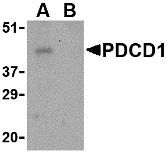
Western blot analysis of PD-1 in THP-1 cell lysate with PD-1 antibody at 1 ug/mL in the (A) absence and (B) presence of blocking peptide.Application
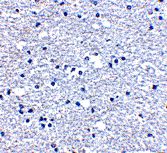
Immunohistochemistry of PD-1 in human brain tissue with PD-1 antibody at 5 ug/mL.| Product Name | PD1 antibody |
|---|---|
| Antibody Type | Primary Antibodies |
| Product description | Rabbit Polyclonal antibody to PD1This gene encodes a cell surface membrane protein of the immunoglobulin superfamily. This protein is expressed in pro-B-cells and is thought to play a role in their differentiation. In mice, expression of this gene is induced in the thymus when anti-CD3 antibodies are injected and large numbers of thymocytes undergo apoptosis. Mice deficient for this gene bred on a BALB/c background developed dilated cardiomyopathy and died from congestive heart failure. These studies suggest that this gene product may also be important in T cell function and contribute to the prevention of autoimmune diseases. [provided by RefSeq, Jul 2008] |
| Immunogen | PD-1 antibody was raised against a 16 amino acid synthetic peptide from near the center of human PD-1. |
| Clonality | Polyclonal |
|---|---|
| Isotype | IgG |
| Host Species | Rabbit |
| Tested Applications | ELISAIHC-PWB |
| IHC-P: 5 ug/mL: |
|
| Species Reactivity | Human |
| Concentration | 1mg/ml (Please refer to the vial label for the specific concentration) |
| Purification | Affinity purified |
| Gene Synonyms | CD279 hSLE1 hPD-1 PD-1 programmed cell death 1 hPD-l PDCD1 SLEB2 |
|---|---|
| Target | PD1 |
Application
Western blot analysis of PD-1 in THP-1 cell lysate with PD-1 antibody at 1 ug/mL in the (A) absence and (B) presence of blocking peptide.
Application
Immunohistochemistry of PD-1 in human brain tissue with PD-1 antibody at 5 ug/mL.| Application Notes | IHC-P: 5 ug/mL: |
|---|
| Form | Liquid |
|---|---|
| Storage Instructions | Be stored at 4oC for three months and -20oC, stable for up to one year. As with all antibodies care should be taken to avoid repeated freeze thaw cycles. Antibodies should not be exposed to prolonged high temperatures. |
| Storage Buffer | PBS containing 0.02% sodium azide. |


