Application
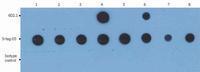
Dot Blot analysis of GST and GST-fusion proteins using anti-PKAc (6D2.1) and anti-GST (S-tag-05). The total amount of material spotted on the nitrocellulose membrane is 5 ng/spot. Lane 1: GST-Akt1. Lane 2: GST-Akt2. Lane 3: GST-Akt3. Lane 4: GST-PKAc alpha. Lane 5: GST-PKAc beta. Lane 6: GST-PKAc gamma. Lane 7: GST-MEK 1. Lane 8: GST| Product Name | PKA C alpha antibody [6D2.1] |
|---|---|
| Antibody Type | Primary Antibodies |
| Product description | Mouse Monoclonal antibody [6D2.1] to PKA C alphaProtein kinase A (PKA, cAMP-dependent protein kinase) is a key element of a ubiquitous signaling pathway important in the cell cycle, cellular communication, memory formation and behavior. PKA is composed of two catalytic (PKAc; Protein Kinase A catalytic subunit) and two regulatory subunits (PKAr). Upon binding cAMP, the complex dissociates to PKAr dimer and two activated PKAc ser/thr protein kinase catalytic monomers. The released PKAc can translocate into the nucleus and exert a regulatory role in the activation of multiple nuclear hormone receptors. However, PKAc-mediated activation of tonicity-dependent gene expression is cAMP independent. Humans express three types of PKAc subunit – PKAc alpha is present in most human tissues, PKAc beta and gamma are tissue-specific, the later is found in testes.Entrez Gene (PKAc alpha): 19p13.1 |
| Immunogen | Peptide corresponding to amino acids ESPAQNTAHLDQFERIK of human proteinkinase A c alpha (PKAc alpha). |
| Clonality | Monoclonal |
|---|---|
| Isotype | IgG1 |
| Clone Number | 6D2.1 |
| Host Species | Mouse |
| Tested Applications | DotWB |
| WB: Use at 0.5-1 µg/mL. Positive Control: HeLa human cervix carcinoma cell line. Note: To detect PKAc gamma, use a more concentrated lysate from a tissue expressing this subunit (testis) | |
| Species Reactivity | Human |
| Concentration | 1mg/ml |
| Gene Synonyms | MGC102831, MGC48865, PKACA |
|---|---|
| Target | PKAc |
| Tissue Specificity | The antibody 6D2.1 strongly reacts with human proteinkinase A catalytic (PKAc) alpha subunit, and weakly with PKAc gamma subunit (both around 40 kDa). The recognized epitope of PKAc alpha is identical between man, sheep, pig, ox and dog. |
| Cellular Localization | Translocates into the nucleus (monomeric catalytic subunit) (By similarity). The inactive holoenzyme is found in the cytoplasm. |
Application
Dot Blot analysis of GST and GST-fusion proteins using anti-PKAc (6D2.1) and anti-GST (S-tag-05). The total amount of material spotted on the nitrocellulose membrane is 5 ng/spot. Lane 1: GST-Akt1. Lane 2: GST-Akt2. Lane 3: GST-Akt3. Lane 4: GST-PKAc alpha. Lane 5: GST-PKAc beta. Lane 6: GST-PKAc gamma. Lane 7: GST-MEK 1. Lane 8: GST| Application Notes | WB: Use at 0.5-1 µg/mL. Positive Control: HeLa human cervix carcinoma cell line. Note: To detect PKAc gamma, use a more concentrated lysate from a tissue expressing this subunit (testis) |
|---|
| Form | Liquid |
|---|---|
| Storage Instructions | Store at 2-8°C. Do not use after expiration date stamped on vial label. For long-term storage aliquot and store at -20°C. Avoid freeze/thaw cycles. |
| Storage Buffer | Phosphate buffered saline (PBS) with 15 mM sodium azide, approx. pH 7.4 |


