Application
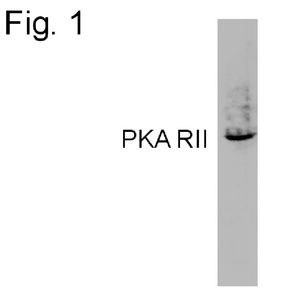
Western blot of PKA RII in human saliva.| Product Name | PKA R2 antibody [H2 006 D4] |
|---|---|
| Antibody Type | Primary Antibodies |
| Product description | Mouse monoclonal antibody [H2 006 D4] to PKA RIIcAMP is a signaling molecule important for a variety of cellular functions. cAMP exerts its effects by activating the cAMP-dependent protein kinase, which transduces the signal through phosphorylation of different target proteins. The inactive kinase holoenzyme is a tetramer composed of two regulatory and two catalytic subunits. cAMP causes the dissociation of the inactive holoenzyme into a dimer of regulatory subunits bound to four cAMP and two free monomeric catalytic subunits. Four different regulatory subunits and three catalytic subunits have been identified in humans. The protein encoded by this gene is one of the regulatory subunits. This subunit can be phosphorylated by the activated catalytic subunit. It may interact with various A-kinase anchoring proteins and determine the subcellular localization of cAMP-dependent protein kinase. This subunit has been shown to regulate protein transport from endosomes to the Golgi apparatus and further to the endoplasmic reticulum (ER). [pr |
| Immunogen | Column purified fraction of cAMP dependent PKA RII from human saliva. |
| Clonality | Monoclonal |
|---|---|
| Isotype | IgG2 |
| Clone Number | H2 006 D4 |
| Host Species | Mouse |
| Tested Applications | WB |
| WB: 1:1,000 Optimal dilution / concentration should be determined by the end user. | |
| Species Reactivity | Human |
| Concentration | 1mg/ml |
| Gene Synonyms | PKR2 , PRKAR2A , protein kinase, cAMP-dependent, regulatory, type II, alpha , PRKAR2 |
|---|---|
| Target | PKA RII |
| Tissue Specificity | This antibody does not discriminate between RII alpha and beta. |
Application
Western blot of PKA RII in human saliva.| Application Notes | WB: 1:1,000 Optimal dilution / concentration should be determined by the end user. |
|---|
| Form | Liquid |
|---|---|
| Storage Instructions | -20° C, Avoid Freeze/Thaw Cycles |
| Storage Buffer | Ascites containing 0.05 % sodium azide |


