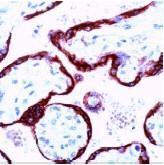
Application
Staining of human placenta with| Product Name | Placental lactogen antibody (ready-to-use) |
|---|---|
| Antibody Type | Primary Antibodies |
| Product description | Rabbit polyclonal to Human placental lactogen predilutedPlacental lactogen is a member of the somatotropin/prolactin family of hormones and plays an important role in growth control. The gene is located at the growth hormone locus on chromosome 17 along with four other related genes in the same transcriptional orientation; an arrangement which is thought to have evolved by a series of gene duplications. Although the five genes share a remarkably high degree of sequence identity, they are expressed selectively in different tissues. Alternative splicing generates additional isoforms of each of the five growth hormones, leading to further diversity and potential for specialization. This particular family member is expressed mainly in the placenta and utilizes multiple transcription initiation sites. |
| Immunogen | Purified human placental lactogen |
| Clonality | Polyclonal |
|---|---|
| Isotype | IgG |
| Host Species | Rabbit |
| Tested Applications | IHC-P |
| IHC-P: Working dilution, ready to use for 10 minutes at RT. Staining of formalin-fixed tissues requires boiling tissue sections in 10mM citrate buffer, pH 6.0 for 10 minutes followed by cooling at RT for 20 minutes. GTX15555 shows cytoplasmic staining. Optimal dilutions/concentrations should be determined by the end user. | |
| Species Reactivity | Human |
| Concentration | 1mg/ml |
| Purification | Affinity purified |
| Gene Synonyms | CSA, CSH2, CSMT, FLJ75407, PL |
|---|---|
| Target | Placental lactogen |
| Cellular Localization | Secreted |
Application
Staining of human placenta with| Positive Control | Placenta |
|---|---|
| Application Notes | IHC-P: Working dilution, ready to use for 10 minutes at RT. Staining of formalin-fixed tissues requires boiling tissue sections in 10mM citrate buffer, pH 6.0 for 10 minutes followed by cooling at RT for 20 minutes. GTX15555 shows cytoplasmic staining. Optimal dilutions/concentrations should be determined by the end user. |
| Form | Liquid |
|---|---|
| Storage Instructions | Keep as concentrated solution. Store at 4ºC short term. For extended storage aliquot and store at -20ºC or below. Avoid freeze-thaw cycles. |
| Storage Buffer | Preservative: Sodium Azide; Constituents: PBS, BSA |


