Application
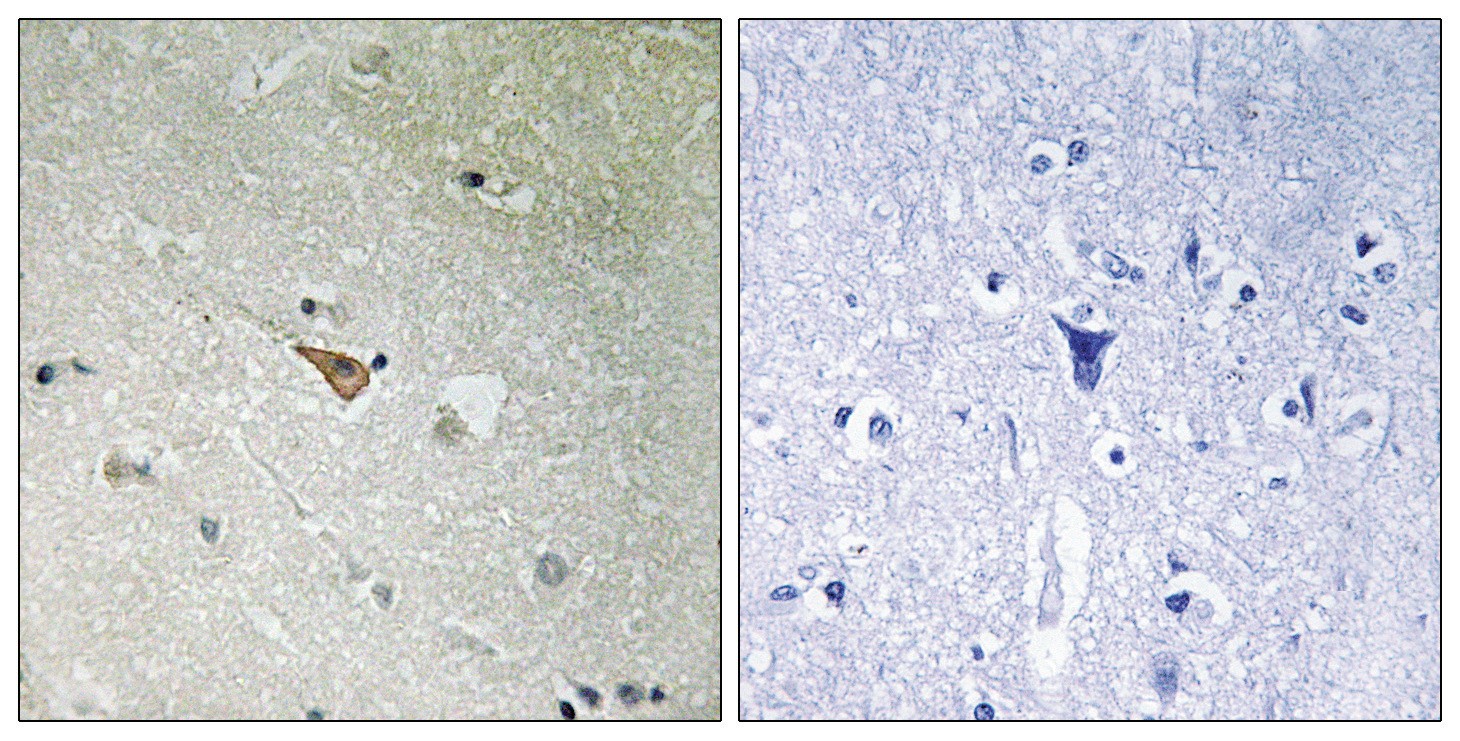
Immunohistochemical analysis of paraffin-embedded human brain tissue, using ALK (Phospho-Tyr1096) antibody (left) or the same antibody preincubated with blocking peptide (right).| Product Name | ALK (phospho Tyr1096) Antibody |
|---|---|
| Antibody Type | Primary Antibodies |
| Antigen Alias | ALK tyrosine kinase receptor, anaplastic lymphoma kinase, anaplastic lymphoma kinase (Ki-1), CD246; EC 2.7.10.1, kinase ALK |
| Product description | The 2;5 chromosomal translocation is frequently associated with anaplastic large cell lymphomas (ALCLs). The translocation creates a fusion gene consisting of the ALK (anaplastic lymphoma kinase) gene and the nucleophosmin (NPM) gene: the 3' half of ALK, derived from chromosome 2, is fused to the 5' portion of NPM from chromosome 5. A recent study shows that the product of the NPM-ALK fusion gene is oncogenic. The deduced amino acid sequences reveal that ALK is a novel receptor protein-tyrosine kinase having a putative transmembrane domain and an extracellular domain.1) Morris S.W., Oncogene 14:2175-2188(1997). |
| Immunogen | ALK (phospho Tyr1096) antibody was raised against a peptide sequence around phosphorylation site of tyrosine 1096 (P-N-Y (p)-C-F) derived from Human ALK. |
| Modification | p-Tyr1096 |
| Clonality | Polyclonal |
|---|---|
| Isotype | IgG |
| Host Species | Rabbit |
| Tested Applications | IHC |
| IHC:1:50~1:200 Notes:Optimal dilutions/concentrations should be determined by the researcher. |
|
| Species Reactivity | HumanMouse |
| Concentration | 1mg/ml |
| Purification | Affinity purified |
| Gene Symbol | Alk |
|---|---|
| Alternative Names | ALK tyrosine kinase receptor anaplastic lymphoma kinase anaplastic lymphoma kinase (Ki-1) CD246 EC 2.7.10.1 kinase ALK |
| Molecular Weight(MW) | 176 kDa |
| Tissue Specificity | The antibody detects endogenous levels of ALK only when phosphorylated at tyrosine 1096. |
| Entrez Gene | 238 |
|---|---|
| Protein Accession | NP_004295.2 |
Application
Immunohistochemical analysis of paraffin-embedded human brain tissue, using ALK (Phospho-Tyr1096) antibody (left) or the same antibody preincubated with blocking peptide (right).| Application Notes | IHC:1:50~1:200 Notes:Optimal dilutions/concentrations should be determined by the researcher. |
|---|
| Form | Liquid |
|---|---|
| Storage Instructions | Store antibody at -20˚C for up to one year. |
| Storage Buffer | Antibody supplied in phosphate buffered saline (without Mg2+ and Ca2+), pH 7.4, 150mM NaCl, 0.02% sodium azide and 50% glycerol. |


