Application
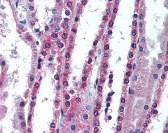
Immunohistochemistry staining of APIP in kidney tissue using APIP Antibody.| Product Name | APIP Antibody |
|---|---|
| Antibody Type | Primary Antibodies |
| Antigen Alias | APIP, APAF1-interacting protein, APIP2, CGI29, CGI-29, DJ179L10.2, MTRu-1-P dehydratase, APAF1 interacting protein, MMRP19 |
| Product description | The mammalian homologues of the key cell death gene CED-4 in C. elegans has been identified recently from human and mouse and designated Apaf1 (for apoptosis protease-activating factor 1) (1,2). Apaf1 binds to cytochrome c (Apaf2) and caspase-9 (Apaf3), which leads to caspase-9 activation. Activated caspase-9 in turn cleaves and activates caspase-3 that is one of the key proteases, being responsible for the proteolytic cleavage of many key proteins in apoptosis. Recently, Cho et al have identified a new Apaf-1 Interactiong Protein (APIP) also known as CG129 and MMRP19, as a negative regulator of ischemic injury. APIP competes with Caspase-9 binding site of Apaf1. APIP is predicted to code for a 204 amino acid. An isoform of APIP, APIP2 encodes a 242 amino acid protein, which is an alternative splicing variant differing in its N-terminus from APIP. APIP transcript is ubiquitously expressed in most adult tissue with high expression in skeletal muscle, heart, and kidney. |
| Immunogen | APIP antibody was raised against a full - length His - tagged recombinant APIP protein. of APIP (Human). |
| Clonality | Polyclonal |
|---|---|
| Isotype | IgG |
| Host Species | Rabbit |
| Tested Applications | IHCWB |
| APimmunoprecipitation antibody can be used in ELISA, Western Blot, immunohistochemistry starting at 5 μg/mL, and immunofluorescence starting at 10 μg/mL.: |
|
| Species Reactivity | Human |
| Concentration | 1mg/ml |
| Purification | Protein G |
| Gene Symbol | APIP |
|---|---|
| Alternative Names | APIP APAF1-interacting protein APIP2 CGI29 CGI-29 DJ179L10.2 MTRu-1-P dehydratase APAF1 interacting protein MMRP19 |
| Tissue Specificity | This polyclonal can be used for detection of APIP and APIP2. |
Application
Immunohistochemistry staining of APIP in kidney tissue using APIP Antibody.| Application Notes | APimmunoprecipitation antibody can be used in ELISA, Western Blot, immunohistochemistry starting at 5 μg/mL, and immunofluorescence starting at 10 μg/mL.: |
|---|
| Form | Liquid |
|---|---|
| Storage Instructions | APIP antibody can be stored short term 4 ˚C. For long term storage aliquot and store at -20 ˚C. As with all antibodies avoid freeze/thaw cycles. |
| Storage Buffer | PBS, 0.2% gelatin, 0.05% sodium azide. |


