Application
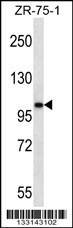
Western blot analysis in ZR-75-1 cell line lysates (35ug/lane).This demonstrates the detected the AR protein (arrow).| Product Name | AR Antibody |
|---|---|
| Antibody Type | Primary Antibodies |
| Antigen Alias | Androgen receptor, Dihydrotestosterone receptor, Nuclear receptor subfamily 3 group C member 4, AR, DHTR, NR3C4 |
| Product description | The androgen receptor gene is more than 90 kb long and codes for a protein that has 3 major functional domains: the N-terminal domain, DNA-binding domain, and androgen-binding domain. The protein functions as a steroid-hormone activated transcription factor. Upon binding the hormone ligand, the receptor dissociates from accessory proteins, translocates into the nucleus, dimerizes, and then stimulates transcription of androgen responsive genes. This gene contains 2 polymorphic trinucleotide repeat segments that encode polyglutamine and polyglycine tracts in the N-terminal transactivation domain of its protein. Expansion of the polyglutamine tract causes spinal bulbar muscular atrophy (Kennedy disease). Mutations in this gene are also associated with complete androgen insensitivity (CAIS). Two alternatively spliced variants encoding distinct isoforms have been described. [provided by RefSeq].1) Shu, S.K., et al. J. Biol. Chem. 285(43):33045-33053(2010) |
| Immunogen | This AR antibody is generated from rabbits immunized with a KLH conjugated synthetic peptide between 475-504 amino acids from the Central region of human AR. |
| Clonality | Polyclonal |
|---|---|
| Isotype | Ig |
| Host Species | Rabbit |
| Tested Applications | WB |
| For WB starting dilution is: 1:1000: |
|
| Species Reactivity | Human |
| Concentration | 1mg/ml |
| Purification | Affinity purified |
| Gene Symbol | AR |
|---|---|
| Alternative Names | Androgen receptor Dihydrotestosterone receptor Nuclear receptor subfamily 3 group C member 4 AR DHTR NR3C4 |
| Molecular Weight(MW) | 99 kDa |
Application
Western blot analysis in ZR-75-1 cell line lysates (35ug/lane).This demonstrates the detected the AR protein (arrow).| Application Notes | For WB starting dilution is: 1:1000: |
|---|
| Form | Liquid |
|---|---|
| Storage Instructions | Store at 4˚C for three months and -20˚C, stable for up to one year. As with all antibodies care should be taken to avoid repeated freeze thaw cycles. Antibodies should not be exposed to prolonged high temperatures. |
| Storage Buffer | Supplied in PBS with 0.09% (W/V) sodium azide. |


