Application
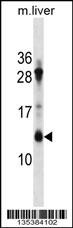
Western blot analysis in mouse liver tissue lysates (35ug/lane).| Product Name | ATP5G1 Antibody |
|---|---|
| Antibody Type | Primary Antibodies |
| Antigen Alias | ATP synthase F(0) complex subunit C1, mitochondrial, ATP synthase lipid-binding protein, ATP synthase proteolipid P1, ATP synthase proton-transporting mitochondrial F(0) complex subunit C1, ATPase protein 9, ATPase subunit c, ATP5G1 |
| Product description | This gene encodes a subunit of mitochondrial ATP synthase. Mitochondrial ATP synthase catalyzes ATP synthesis, utilizing an electrochemical gradient of protons across the inner membrane during oxidative phosphorylation. ATP synthase is composed of two linked multi-subunit complexes: the soluble catalytic core, F1, and the membrane-spanning component, Fo, comprising the proton channel. The catalytic portion of mitochondrial ATP synthase consists of 5 different subunits (alpha, beta, gamma, delta, and epsilon) assembled with a stoichiometry of 3 alpha, 3 beta, and a single representative of the other 3. The proton channel seems to have nine subunits (a, b, c, d, e, f, g, F6 and 8). This gene is one of three genes that encode subunit c of the proton channel. Each of the three genes have distinct mitochondrial import sequences but encode the identical mature protein. Alternatively spliced transcript variants encoding the same protein have been identified.1) Vives-Bauza, C., et al. Mol. Biol. Cell 21(1):131-139(2010) |
| Immunogen | This ATP5G1 antibody is generated from rabbits immunized with a KLH conjugated synthetic peptide between 27-56 amino acids from the Central region of human ATP5G1. |
| Clonality | Polyclonal |
|---|---|
| Isotype | Ig |
| Host Species | Rabbit |
| Tested Applications | WB |
| For WB starting dilution is: 1:1000: |
|
| Species Reactivity | HumanMouse |
| Concentration | 1mg/ml |
| Purification | Affinity purified |
| Gene Symbol | ATP5G1 |
|---|---|
| Alternative Names | ATP synthase F(0) complex subunit C1 mitochondrial ATP synthase lipid-binding protein ATP synthase proteolipid P1 ATP synthase proton-transporting mitochondrial F(0) complex subunit C1 ATPase protein 9 ATPase subunit c ATP5G1 |
| Molecular Weight(MW) | 14 kDa |
Application
Western blot analysis in mouse liver tissue lysates (35ug/lane).| Application Notes | For WB starting dilution is: 1:1000: |
|---|
| Form | Liquid |
|---|---|
| Storage Instructions | Store at 4˚C for three months and -20˚C, stable for up to one year. As with all antibodies care should be taken to avoid repeated freeze thaw cycles. Antibodies should not be exposed to prolonged high temperatures. |
| Storage Buffer | Supplied in PBS with 0.09% (W/V) sodium azide. |


