Application
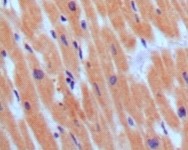
Immunohistochemical analysis of paraffin - embedded human normal myocardium showing cytoplasma localization using BNP3 antibody with DAB staining.| Product Name | BNP3 Antibody |
|---|---|
| Antibody Type | Primary Antibodies |
| Antigen Alias | Gamma-brain natriuretic peptide, BNP-32, BNP |
| Product description | BNP (brain natriuretic peptide) belongs to a family of structurally similar peptide hormones, which includes atrial natriuretic peptide (ANP), BNP, C-type natriuretic peptide (CNP) and urodilatin. ANP and BNP act mainly as cardiac hormones, produced primarily by the atrium and ventricle, respectively, while the gene encoding C-type natriuretic peptide is expressed mainly in the brain. BNP circulates in blood as a peptide hormone with natriuretic, vasodilatory and renin inhibitory properties. It is secreted predominantly by the left ventricular myocytes in response to volume expansion and pressure overload. These peptides are characterized by a common 17 amino acid ring structure with a disulfide bond between two cystein residues. This ring structure shows high homology between different natriuretic.1) Dawson A. Struthers AD. Expert Opin Biol Ther. 2003, Feb, 3(1):107-12. Review. |
| Immunogen | Synthetic peptide corresponding to aa (Glu-Pro-Leu-Gln-Glu-Ser-Pro-Arg-Pro-Thr-Gly-Val-Trp-Cys) of human BNP3. |
| Clonality | Monoclonal |
|---|---|
| Isotype | IgG1 |
| Host Species | Mouse |
| Tested Applications | IHC |
| IHC(P):1:500 - 1:2,000 ELISA:Propose dilution 1:10,000. Determining optimal working dilutions by titration test.: |
|
| Species Reactivity | Human |
| Concentration | 1mg/ml |
| Gene Symbol | NPPB |
|---|---|
| Alternative Names | Gamma-brain natriuretic peptide BNP-32 BNP |
Application
Immunohistochemical analysis of paraffin - embedded human normal myocardium showing cytoplasma localization using BNP3 antibody with DAB staining.| Positive Control | 1) Cat. No. 1301 - Human Heart Tissue Lysate |
|---|---|
| Application Notes | IHC(P):1:500 - 1:2,000 ELISA:Propose dilution 1:10,000. Determining optimal working dilutions by titration test.: |
| Form | Liquid |
|---|---|
| Storage Instructions | BNP3 monoclonal antibody can be stored at -20˚C, stable for one year. As with all antibodies care should be taken to avoid repeated freeze thaw cycles. Antibodies should not be exposed to prolonged high temperatures. |
| Storage Buffer | phosphate buffered saline , pH 7.4, 150mM NaCl, 0.02% sodium azide and 50% glycerol. |


