Application
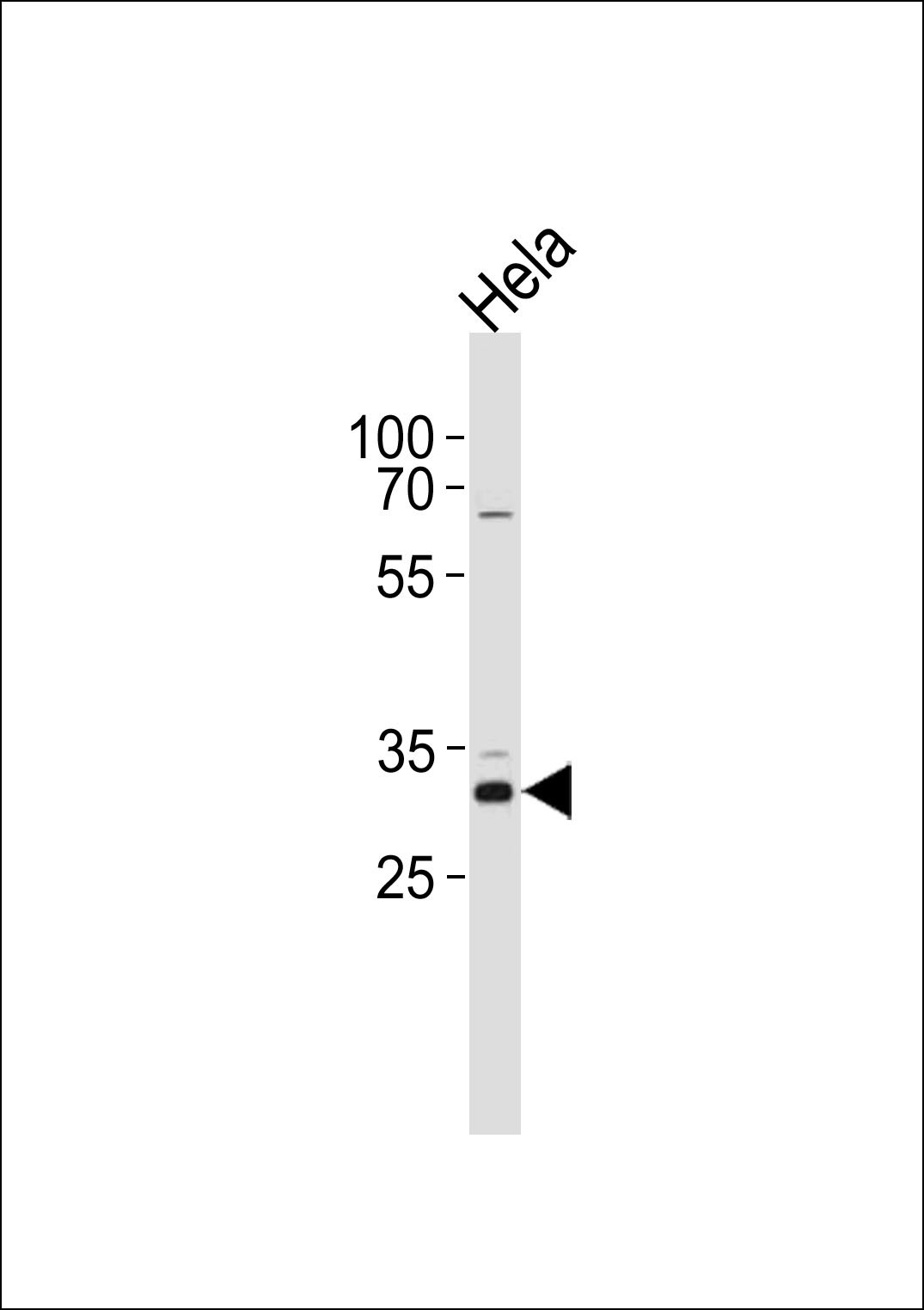
Western blot analysis in Hela cell line lysates (35ug/lane).| Product Name | CCND1 Antibody |
|---|---|
| Antibody Type | Primary Antibodies |
| Antigen Alias | G1/S-specific cyclin-D1, B-cell lymphoma 1 protein, BCL-1, BCL-1 oncogene, PRAD1 oncogene, CCND1, BCL1, PRAD1 |
| Product description | The protein encoded by this gene belongs to the highly conserved cyclin family, whose members are characterized by a dramatic periodicity in protein abundance throughout the cell cycle. Cyclins function as regulators of CDK kinases. Different cyclins exhibit distinct expression and degradation patterns which contribute to the temporal coordination of each mitotic event. This cyclin forms a complex with and functions as a regulatory subunit of CDK4 or CDK6, whose activity is required for cell cycle G1/S transition. This protein has been shown to interact with tumor suppressor protein Rb and the expression of this gene is regulated positively by Rb. Mutations, amplification and overexpression of this gene, which alters cell cycle progression, are observed frequently in a variety of tumors and may contribute to tumorigenesis.1) Aggarwal, P., et al. Cancer Cell 18(4):329-340(2010) Iwatani, K., et al. Biochem. Biophys. Res. Commun. 400(3):426-431(2010) Halilovic, E., et al. Cancer Res. 70(17):6804-6814(2010) Zheng, W., et al. Anal. Quant. Cytol. Histol. 32(3):155-160(2010) Satiroglu-Tufan, N.L., et al. Genet. Mol. Res. 9(3):1557-1567(2010) |
| Immunogen | This CCND1 antibody is generated from rabbits immunized with a KLH conjugated synthetic peptide between 267-294 amino acids from the C-terminal region of human CCND1. |
| Clonality | Polyclonal |
|---|---|
| Isotype | Ig |
| Host Species | Rabbit |
| Tested Applications | WB |
| For WB starting dilution is: 1:1000: |
|
| Species Reactivity | Human |
| Concentration | 1mg/ml |
| Purification | Affinity purified |
| Gene Symbol | CCND1 |
|---|---|
| Alternative Names | G1/S-specific cyclin-D1 B-cell lymphoma 1 protein BCL-1 BCL-1 oncogene PRAD1 oncogene CCND1 BCL1 PRAD1 |
| Molecular Weight(MW) | 34 kDa |
Application
Western blot analysis in Hela cell line lysates (35ug/lane).| Application Notes | For WB starting dilution is: 1:1000: |
|---|
| Form | Liquid |
|---|---|
| Storage Instructions | Store at 4˚C for three months and -20˚C, stable for up to one year. As with all antibodies care should be taken to avoid repeated freeze thaw cycles. Antibodies should not be exposed to prolonged high temperatures. |
| Storage Buffer | Supplied in PBS with 0.09% (W/V) sodium azide. |


