Application
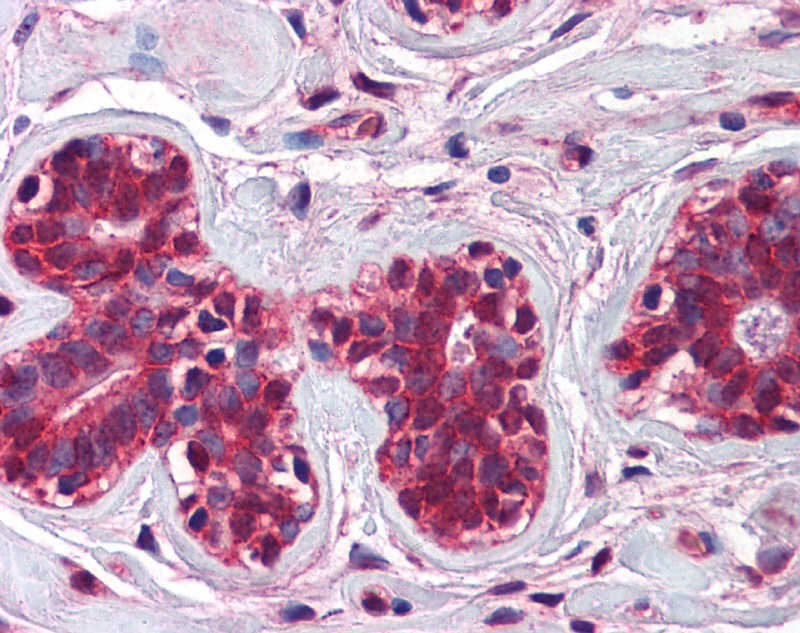
Antibody used in IHC on Human Breast.Application
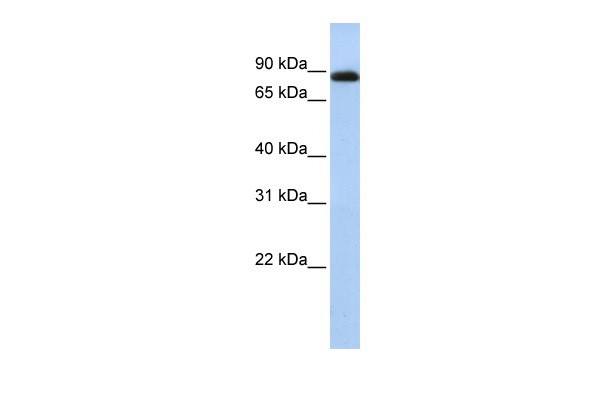
Antibody used in WB on Human HepG2 at 0.2-1 ug/ml.| Product Name | CHFR Antibody |
|---|---|
| Antibody Type | Primary Antibodies |
| Antigen Alias | CHFR, FLJ10796, FLJ33629, RNF116, RNF196 |
| Product description | CHFR is an E3 ubiquitin-protein ligase required to transiently arrest cells in early prophase when they are exposed to microtubule poisons. It acts in early prophase before chromosome condensation, when the centrosome moves apart from each other along the periphery of the nucleus. CHFR probably promotes the formation of 'Lys-63'-linked polyubiquitin chains and functions with the specific ubiquitin-conjugating UBC13-MMS2 (UBE2N-UBE2V2) heterodimer. Substrates that are polyubiquitinated at 'Lys-63' are usually not targeted for degradation, but are rather involved in signaling cellular stress. This suggests that it may be involved in signaling the presence of mitotic stress caused by microtubule poisons.1) Kang, H.C., Cancer Lett. 260 (1-2), 170-179 (2008). |
| Immunogen | Antibody produced in rabbits immunized with a synthetic peptide corresponding a region of human CHFR. |
| Clonality | Polyclonal |
|---|---|
| Host Species | Rabbit |
| Tested Applications | ELISAWB |
| CHFR antibody can be used for detection of CHFR by ELISA at 1:312500. CHFR antibody can be used for detection of CHFR by western blot at 1 μg/mL, and HRP conjugated secondary antibody should be diluted 1:50,000 - 100,000.: |
|
| Species Reactivity | HumanMouseRat |
| Concentration | 1mg/ml |
| Purification | Affinity purified |
| Gene Symbol | CHFR |
|---|---|
| Alternative Names | CHFR FLJ10796 FLJ33629 RNF116 RNF196 |
| Molecular Weight(MW) | 69 kDa |
Application
Antibody used in IHC on Human Breast.
Application
Antibody used in WB on Human HepG2 at 0.2-1 ug/ml.| Positive Control | 1) Cat. No. 1211 - HepG2 Cell Lysate |
|---|---|
| Application Notes | CHFR antibody can be used for detection of CHFR by ELISA at 1:312500. CHFR antibody can be used for detection of CHFR by western blot at 1 μg/mL, and HRP conjugated secondary antibody should be diluted 1:50,000 - 100,000.: |
| Form | Liquid |
|---|---|
| Storage Instructions | For short periods of storage (days) store at 4˚C. For longer periods of storage, store CHFR antibody at -20˚C. As with any antibody avoid repeat freeze-thaw cycles. |
| Storage Buffer | Antibody is lyophilized in PBS buffer with 2% sucrose. Add 50 μL of distilled water. Final antibody concentration is 1 mg/mL. |


