Application
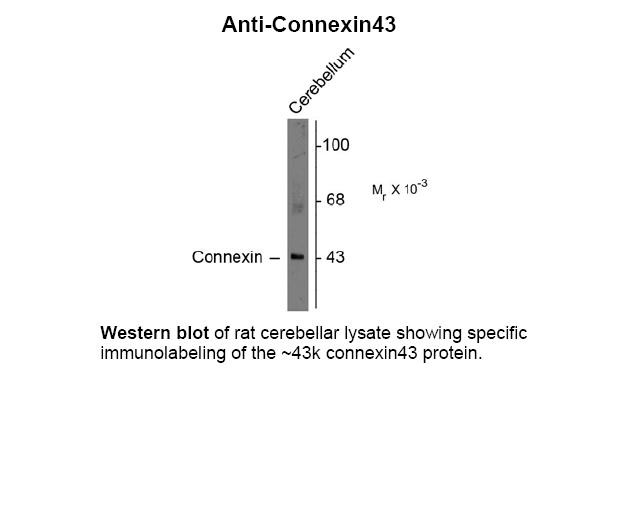
Western blot of rat cerebellar lysate showing specific immunolabeling of the ~43k connexin43 protein.| Product Name | Connexin Antibody |
|---|---|
| Antibody Type | Primary Antibodies |
| Antigen Alias | Cx43, Cxn-43, Connexin-43, Cx43 |
| Product description | Gap junctional intercellular communication is thought to play a key role in development and may also be involved in epilepsy (Aronica et al., 2001). Connexin43 forms gap-junctional channels and regulates the permeability of these gap junctions to small organic molecules. Permeability of connexin43 is known to be regulated by phosphorylation at er368 by protein kinase C (Yogo et al., 2002; Bao et al., 2004a). Phosphorylation of Ser368 by PKC induces a conformational change of connexin43 that results in a decrease in gap junction permeability (Bao et al., 2004b).1) Aronica E, Gorter JA, Jansen GH, Leenstra S, Yankaya B, Troost D (2001) Expression of connexin 43 and connexin 32 gap-junction proteins in epilepsy-associated brain tumors and in the perilesional epileptic cortex. Acta Neuropathol (Berl) 101:449-459. |
| Immunogen | Peptide corresponding to amino acid residues from the C-terminal region of rat connexin43. |
| Clonality | Polyclonal |
|---|---|
| Host Species | Rabbit |
| Tested Applications | WB |
| The antibody has been directly tested for reactivity in Western blots in rat tissues. It is anticipated that the antibody will also work with chicken, dog, finch, human, mouse, non-human primate, sheep, Xenopus and zebra fish tissues based on the fact that these species have 100% homology with the amino acid sequence used as antigen.: |
|
| Species Reactivity | ChickenDogHumanMouseRatSheepXenopusZebra Fish |
| Concentration | 1mg/ml |
| Purification | Affinity purified |
| Gene Symbol | Gja1 |
|---|---|
| Alternative Names | Cx43 Cxn-43 Connexin-43 Cx43 |
| Molecular Weight(MW) | 43 |
Application
Western blot of rat cerebellar lysate showing specific immunolabeling of the ~43k connexin43 protein.| Application Notes | The antibody has been directly tested for reactivity in Western blots in rat tissues. It is anticipated that the antibody will also work with chicken, dog, finch, human, mouse, non-human primate, sheep, Xenopus and zebra fish tissues based on the fact that these species have 100% homology with the amino acid sequence used as antigen.: |
|---|
| Form | Liquid |
|---|---|
| Storage Instructions | Connexin antibody can be stored at -20˚C and is stable at -20˚C for at least 1 year. |
| Storage Buffer | 100 uL in 10 mM HEPES (pH 7.5), 150 mM NaCl, 100 ug per mL BSA and 50% glycerol. |


