Application
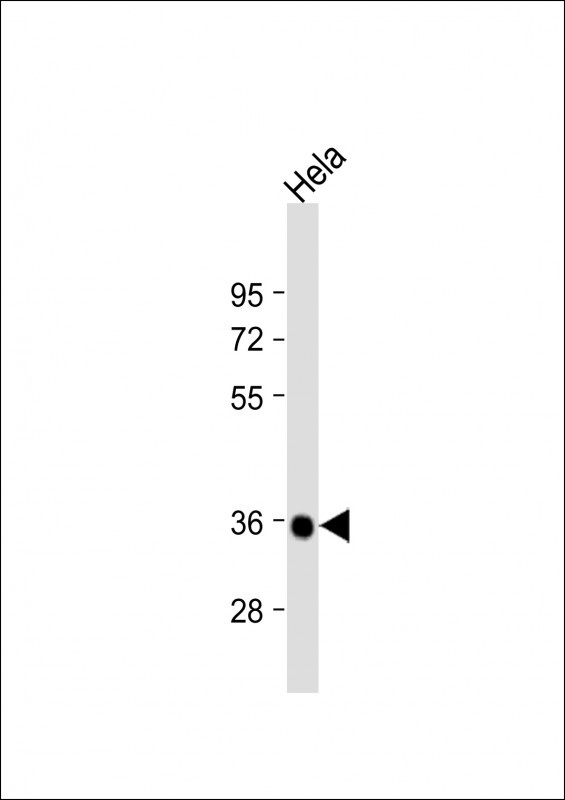
Western Blot at 1:1000 dilution + Hela whole cell lysate Lysates/proteins at 20 ug per lane.| Product Name | Deoxyguanosine Kinase Antibody |
|---|---|
| Antibody Type | Primary Antibodies |
| Antigen Alias | Deoxyguanosine kinase, mitochondrial, dGK, DGUOK, DGK |
| Product description | Mitochondrial deoxyguanosine kinase (DGUOK) is required for the phosphorylation of several deoxyribonucleosides and certain purine deoxykribonucleoside analogs widely employed as antiviral and chemotherapeutic agents. Purine deoxyribonucleoside analogs are extensively used in treatment of lymphoproliferative disorders. These compounds are administered as pro-drugs, and their efficiency is dependent on intracellular phosphorylation to the corresponding triphosphates. In mammalian cells, the phosphorylation of purine deoxyribonucleosides is mediated predominantly by 2 deoxyribonucleoside kinases: cytosolic deoxycytidine kinase (DCK) and mitochondrial deoxyguanosine kinase (DGUOK also known as DGK). DGUOK expression is ubiquitous, with highest levels in muscle, brain, liver and lymphoid tissues. Defects in DGUOK are a cause of mitochondrial DNA depletion syndrome (MDS). MDS is a clinically heterogeneous group of disorders characterized by a reduction in mitochondrial DNA (mtDNA) copy number. Primary mtDNA depletion is inherited as an autosomal recessive trait and may affect single organs, typically muscle or liver, or multiple tissues. Mitochondrial DNA depletion syndromes are phenotypically heterogeneous, autosomal recessive disorders characterized by tissue-specific reduction in mtDNA copy number. Affected individuals with the hepatocerebral form of mtDNA depletion syndrome have early progressive liver failure and neurologic abnormalities, hypoglycemia, and increased lactate in body fluids. |
| Immunogen | This Deoxyguanosine Kinase (DGUOK) antibody is generated from rabbits immunized with a KLH conjugated synthetic peptide between 241-271 amino acids from the C-terminal region of human Deoxyguanosine Kinase (DGUOK). |
| Clonality | Polyclonal |
|---|---|
| Isotype | Ig |
| Host Species | Rabbit |
| Tested Applications | WB |
| For WB starting dilution is: 1:1000: |
|
| Species Reactivity | Human |
| Concentration | 1mg/ml |
| Gene Symbol | DGUOK |
|---|---|
| Alternative Names | Deoxyguanosine kinase mitochondrial dGK DGUOK DGK |
| Molecular Weight(MW) | 32 kDa |
Application
Western Blot at 1:1000 dilution + Hela whole cell lysate Lysates/proteins at 20 ug per lane.| Application Notes | For WB starting dilution is: 1:1000: |
|---|
| Form | Liquid |
|---|---|
| Storage Instructions | Store at 4˚C for three months and -20˚C, stable for up to one year. As with all antibodies care should be taken to avoid repeated freeze thaw cycles. Antibodies should not be exposed to prolonged high temperatures. |
| Storage Buffer | Supplied in PBS with 0.09% (W/V) sodium azide. |


