Application
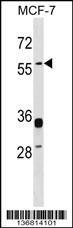
Western blot analysis in MCF-7 cell line lysates (35ug/lane).| Product Name | ERVWE1 Antibody |
|---|---|
| Antibody Type | Primary Antibodies |
| Antigen Alias | Syncytin-1, Endogenous retrovirus group W member 1, Env-W, Envelope polyprotein gPr73, Enverin, HERV-7q Envelope protein, HERV-W envelope protein, HERV-W_7q212 provirus ancestral Env polyprotein, Syncytin, Surface protein, SU, gp50, Transmembrane protein, |
| Product description | Many different human endogenous retrovirus (HERV) families are expressed in normal placental tissue at high levels, suggesting that HERVs are functionally important in reproduction. This gene is part of an HERV provirus on chromosome 7 that has inactivating mutations in the gag and pol genes. This gene is the envelope glycoprotein gene which appears to have been selectively preserved. The gene's protein product is expressed in the placental syncytiotrophoblast and is involved in fusion of the cytotrophoblast cells to form the syncytial layer of the placenta. The protein has the characteristics of a typical retroviral envelope protein, including a furin cleavage site that separates the surface (SU) and transmembrane (TM) proteins which form a heterodimer. Alternatively spliced transcript variants encoding the same protein have been found for this gene.1) Zhao, J., et al. BMC Med. Genet. 11, 96 (2010) : |
| Immunogen | This ERVWE1 antibody is generated from rabbits immunized with a KLH conjugated synthetic peptide between 493-521 amino acids from the C-terminal region of human ERVWE1. |
| Clonality | Polyclonal |
|---|---|
| Isotype | Ig |
| Host Species | Rabbit |
| Tested Applications | WB |
| For WB starting dilution is: 1:1000: |
|
| Species Reactivity | Human |
| Concentration | 1mg/ml |
| Purification | Affinity purified |
| Gene Symbol | ERVW-1 |
|---|---|
| Alternative Names | Syncytin-1 Endogenous retrovirus group W member 1 Env-W Envelope polyprotein gPr73 Enverin HERV-7q Envelope protein HERV-W envelope protein HERV-W_7q212 provirus ancestral Env polyprotein Syncytin Surface protein SU gp50 Transmembrane protein |
| Molecular Weight(MW) | 60 kDa |
Application
Western blot analysis in MCF-7 cell line lysates (35ug/lane).| Application Notes | For WB starting dilution is: 1:1000: |
|---|
| Form | Liquid |
|---|---|
| Storage Instructions | Store at 4˚C for three months and -20˚C, stable for up to one year. As with all antibodies care should be taken to avoid repeated freeze thaw cycles. Antibodies should not be exposed to prolonged high temperatures. |
| Storage Buffer | Supplied in PBS with 0.09% (W/V) sodium azide. |


