Application
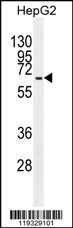
Western blot analysis in HepG2 cell line lysates (35ug/lane).| Product Name | GAD1 Antibody |
|---|---|
| Antibody Type | Primary Antibodies |
| Antigen Alias | Glutamate decarboxylase 1, 67 kDa glutamic acid decarboxylase, GAD-67, Glutamate decarboxylase 67 kDa isoform, GAD1, GAD, GAD67 |
| Product description | This gene encodes one of several forms of glutamic acid decarboxylase, identified as a major autoantigen in insulin-dependent diabetes. The enzyme encoded is responsible for catalyzing the production of gamma-aminobutyric acid from L-glutamic acid. A pathogenic role for this enzyme has been identified in the human pancreas since it has been identified as an autoantigen and an autoreactive T cell target in insulin-dependent diabetes. This gene may also play a role in the stiff man syndrome. Deficiency in this enzyme has been shown to lead to pyridoxine dependency with seizures. Alternative splicing of this gene results in two products, the predominant 67-kD form and a less-frequent 25-kD form.1) Lanoue, A.C., et al. Exp. Neurol. 226(1):207-217(2010) |
| Immunogen | This GAD1 antibody is generated from rabbits immunized with a KLH conjugated synthetic peptide between 514-543 amino acids from the C-terminal region of human GAD1. |
| Clonality | Polyclonal |
|---|---|
| Isotype | Ig |
| Host Species | Rabbit |
| Tested Applications | WB |
| For WB starting dilution is: 1:1000: |
|
| Species Reactivity | Human |
| Concentration | 1mg/ml |
| Purification | Affinity purified |
| Gene Symbol | GAD1 |
|---|---|
| Alternative Names | Glutamate decarboxylase 1 67 kDa glutamic acid decarboxylase GAD-67 Glutamate decarboxylase 67 kDa isoform GAD1 GAD GAD67 |
| Molecular Weight(MW) | 67 kDa |
Application
Western blot analysis in HepG2 cell line lysates (35ug/lane).| Application Notes | For WB starting dilution is: 1:1000: |
|---|
| Form | Liquid |
|---|---|
| Storage Instructions | Store at 4˚C for three months and -20˚C, stable for up to one year. As with all antibodies care should be taken to avoid repeated freeze thaw cycles. Antibodies should not be exposed to prolonged high temperatures. |
| Storage Buffer | Supplied in PBS with 0.09% (W/V) sodium azide. |


