Application
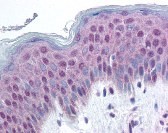
Immunohistochemistry staining of HMGN1 in skin tissue using HMGN1 Antibody.| Product Name | HMGN1 Antibody |
|---|---|
| Antibody Type | Primary Antibodies |
| Antigen Alias | HMGN1, HMG14 |
| Product description | HMGNs are proteins that bind chromatin effectively reducing the compaction of the chromatin fiber and enhancing access to DNA regulatory sequences. Members of this family have a conserved chromatin binding domain which is phosphorylated during mitosis. The sequence immunized is conserved in several species. As such, this reagent is designed as a universal reagent for the detection of all phosphorylated HMGN proteins. The High Mobility Group (HMG) proteins were originally isolated from mammalian cells and were named according to their electrophoretic mobility in polyacrylamide gels. HMGs were arbitrarily classed as a specific type of nonhistone proteins based on the observation that they are ubiquitous to mammalian cells, that they share certain physical properties, and that they are associated with isolated chromatin. HMG proteins and are now subdivided into 3 families: the HMGB (formerly HMG-1/-2) family, the HMGN (formerly HMG-14/-17) family, and the HMGA (formerly HMG-I/Y/C) family. Each HMG family has a characteristic functional sequence motif. The functional motif of the HMGB family is called the "HMG-box;" that of the HMGN family, the "nucleosomal binding domain;" and that of the HMGA family, the "AT-hook." The functional motifs characteristic of these canonical HMGs are widespread among nuclear proteins in a variety of organisms. Proteins containing any of these functional motifs embedded in their sequence are known as "HMG motif proteins." |
| Immunogen | HMGN1 antibody was raised against amino acids 19-28 of HMGN1 (Human). |
| Clonality | Polyclonal |
|---|---|
| Host Species | Rabbit |
| Tested Applications | IFIHC |
| HMGN1 antibody can be used in immunohistochemistry starting at 1:50 - 1:100, immunoprecipitation, and flow cytometry.: |
|
| Species Reactivity | Human |
| Concentration | 1mg/ml |
| Purification | Affinity purified |
| Gene Symbol | HMGN1 |
|---|---|
| Alternative Names | HMGN1 HMG14 |
| Tissue Specificity | pSer20/pSer24 |
Application
Immunohistochemistry staining of HMGN1 in skin tissue using HMGN1 Antibody.| Application Notes | HMGN1 antibody can be used in immunohistochemistry starting at 1:50 - 1:100, immunoprecipitation, and flow cytometry.: |
|---|
| Form | Liquid |
|---|---|
| Storage Instructions | Store HMGN1 antibody at 4 ˚C or -20 ˚C. As with all antibodies avoid freeze/thaw cycles. |
| Storage Buffer | 0.02 M potassium phosphate, 0.15 M sodium chloride, pH 7.2, 0.01% sodium azide. |


