Application
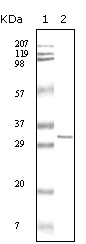
Western blot analysis using anti - human HPRT monoclonal antibody against truncated HPRT recombinant protein.| Product Name | HPRT Antibody |
|---|---|
| Antibody Type | Primary Antibodies |
| Antigen Alias | HPRT, Hypoxanthine-guanine phosphoribosyltransferase, HGPRT |
| Product description | The HPRT1 gene provides instructions for making an enzyme called hypoxanthine phosphoribosyltransferase 1. This enzyme allows cells to recycle purines, some of the building blocks of DNA and its chemical cousin RNA.The enzyme hypoxanthine-guanine phosphoribosyltrasferase (E.C.2.4.2.8., HPRT) plays a crucial role in uric acid synthesis and purine metabolism.This enzyme catalyzes the conversion of hypoxanthine and guanine to inosine monophosphate (IMP) and guanosine monophosphate (GMP), respectively, and uses phosphoribosylpyrophosphate (PRPP) as a cosubstrate and as a source of energy . This pathway is also known as the purine salvage pathway because it allows cells to reuse purine compounds to build DNA and RNA.1) Manjanatha MG, et.al Mutat Res. 2004 Mar 22;547(1-2):5-18. |
| Immunogen | Ni-NTA purified truncated recombinant HPRT expressed in E. Coli strain BL21 (DE3). |
| Clonality | Monoclonal |
|---|---|
| Isotype | IgG2b |
| Host Species | Mouse |
| Tested Applications | ELISAWB |
| Western Blot:Dilution 1:500 - 1:2,000 ELISA:Propose dilution 1:10,000. Determining optimal working dilutions by titration test.: |
|
| Species Reactivity | Human |
| Concentration | 1mg/ml |
| Gene Symbol | HPRT1 |
|---|---|
| Alternative Names | HPRT Hypoxanthine-guanine phosphoribosyltransferase HGPRT |
Application
Western blot analysis using anti - human HPRT monoclonal antibody against truncated HPRT recombinant protein.| Application Notes | Western Blot:Dilution 1:500 - 1:2,000 ELISA:Propose dilution 1:10,000. Determining optimal working dilutions by titration test.: |
|---|
| Form | Liquid |
|---|---|
| Storage Instructions | HPRT monoclonal antibody can be stored at -20˚C, stable for one year. As with all antibodies care should be taken to avoid repeated freeze thaw cycles. Antibodies should not be exposed to prolonged high temperatures. |
| Storage Buffer | phosphate buffered saline , pH 7.4, 150mM NaCl, 0.02% sodium azide and 50% glycerol. |


