Application
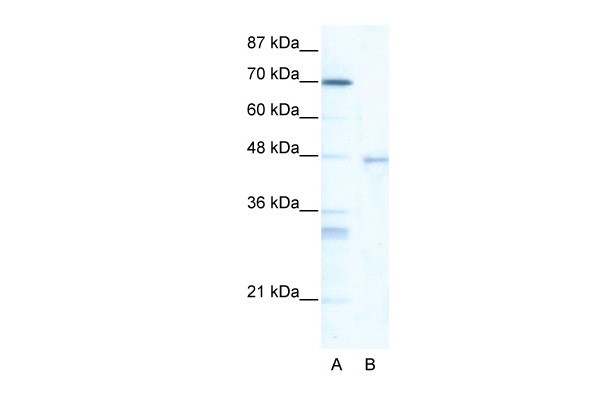
Antibody used in WB on Human HepG2 at 5.0 ug/ml.| Product Name | HSF4 Antibody |
|---|---|
| Antibody Type | Primary Antibodies |
| Antigen Alias | HSF4, CTM, CTRCT5 |
| Product description | Heat-shock transcription factors (HSFs) activate heat-shock response genes under conditions of heat or other stresses. HSF4 lacks the carboxyl-terminal hydrophobic repeat which is shared among all vertebrate HSFs and has been suggested to be involved in the negative regulation of DNA binding activity. Two alternatively spliced transcripts encoding distinct isoforms and possessing different transcriptional activity have been described.1) Kimura, K., et al., (2006) Genome Res. 16 (1), 55-65. |
| Immunogen | Antibody produced in rabbits immunized with a synthetic peptide corresponding a region of human HSF4. |
| Clonality | Polyclonal |
|---|---|
| Host Species | Rabbit |
| Tested Applications | ELISAWB |
| HSF4 antibody can be used for detection of HSF4 by ELISA at 1:312500. HSF4 antibody can be used for detection of HSF4 by western blot at 5 μg/mL, and HRP conjugated secondary antibody should be diluted 1:50,000 - 100,000.: |
|
| Species Reactivity | Human |
| Concentration | 1mg/ml |
| Purification | Protein A |
| Gene Symbol | HSF4 |
|---|---|
| Alternative Names | HSF4 CTM CTRCT5 |
| Molecular Weight(MW) | 50 kDa, 53 kDa |
Application
Antibody used in WB on Human HepG2 at 5.0 ug/ml.| Positive Control | 1) Cat. No. 1211 - HepG2 Cell Lysate |
|---|---|
| Application Notes | HSF4 antibody can be used for detection of HSF4 by ELISA at 1:312500. HSF4 antibody can be used for detection of HSF4 by western blot at 5 μg/mL, and HRP conjugated secondary antibody should be diluted 1:50,000 - 100,000.: |
| Form | Liquid |
|---|---|
| Storage Instructions | For short periods of storage (days) store at 4˚C. For longer periods of storage, store HSF4 antibody at -20˚C. As with any antibody avoid repeat freeze-thaw cycles. |
| Storage Buffer | IgG in phosphate buffered saline , pH 7.4, 150mM NaCl, 0.02% sodium azide and 50% glycerol.Store at -20 °C.Stable for 12 months from date of receipt |


