Application
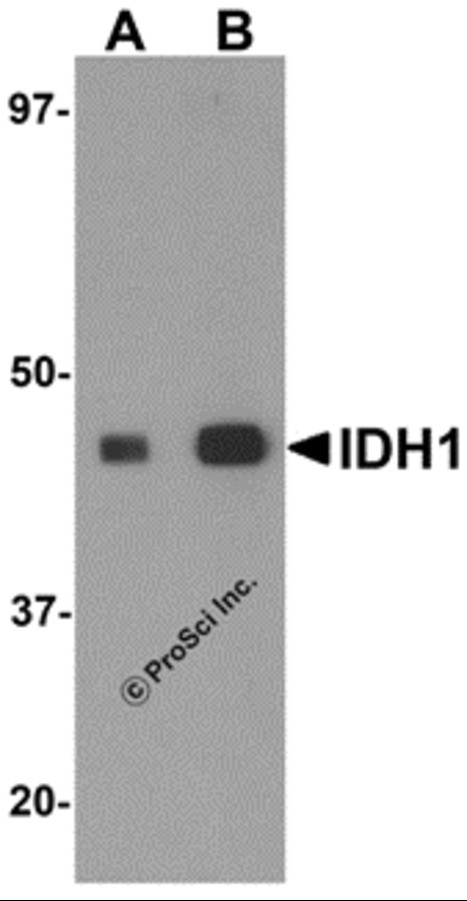
Western blot analysis of IDH1 in HepG2 cell lysate with IDH1 antibody at (A) 1 and (B) 2 μg/mL.| Product Name | IDH1 Antibody |
|---|---|
| Antibody Type | Primary Antibodies |
| Antigen Alias | IDH1 Antibody: IDH, IDP, IDCD, IDPC, PICD, HEL-216, HEL-S-26, Cytosolic NADP-isocitrate dehydrogenase, IDH |
| Product description | IDH1 Antibody: Isocitrate dehydrogenases catalyze the oxidative decarboxylation of isocitrate to 2-oxoglutarate. These enzymes belong to two distinct subclasses, one of which utilizes NAD(+) as the electron acceptor and the other NADP(+). Two NADP(+)-dependent isocitrate dehydrogenases have been found as homodimer: IDH1 is predominantly cytosolic and peroxisomal and IDH2 is mitochondrial. The presence of IDH1 in peroxisomes suggests it may play a role in the regeneration of NADPH for intraperoxisomal reductions, such as the conversion of 2, 4-dienoyl-CoAs to 3-enoyl-CoAs, as well as in peroxisomal reactions that consume 2-oxoglutarate, namely the alpha-hydroxylation of phytanic acid. The cytoplasmic IDH1 serves a significant role in cytoplasmic NADPH production. Defects in IDH1 are involved in the development of glioma.1) Geisbrecht BV and Gould SJ. The human PICD gene encodes a cytoplasmic and peroxisomal NADP(+)-dependent isocitrate dehydrogenase. J. Biol. Chem.1999; 274:30527-33. |
| Immunogen | IDH1 antibody was raised against a 13 amino acid synthetic peptide near the carboxy terminus of human IDH1. The immunogen is located within the last 50 amino acids of IDH1. |
| Clonality | Polyclonal |
|---|---|
| Isotype | IgG |
| Host Species | Rabbit |
| Tested Applications | WB |
| IDH1 antibody can be used for detection of IDH1 by Western blot at 1 - 2 μg/mL.: |
|
| Species Reactivity | Rat |
| Concentration | 1mg/ml |
| Purification | Affinity purified |
| Gene Symbol | IDH1 |
|---|---|
| Alternative Names | IDH1 Antibody: IDH IDP IDCD IDPC PICD HEL-216 HEL-S-26 Cytosolic NADP-isocitrate dehydrogenase IDH |
| Sequence Similarities | Predicted species reactivity based on immunogen sequence: Sheep: (100%) |
Application
Western blot analysis of IDH1 in HepG2 cell lysate with IDH1 antibody at (A) 1 and (B) 2 μg/mL.| Positive Control | 1) Cat. No. 1211 - HepG2 Cell Lysate |
|---|---|
| Application Notes | IDH1 antibody can be used for detection of IDH1 by Western blot at 1 - 2 μg/mL.: |
| Form | Liquid |
|---|---|
| Storage Instructions | IDH1 antibody can be stored at 4˚C for three months and -20˚C, stable for up to one year. As with all antibodies care should be taken to avoid repeated freeze thaw cycles. Antibodies should not be exposed to prolonged high temperatures. |
| Storage Buffer | IDH1 Antibody is supplied in PBS containing 0.02% sodium azide. |


