Application
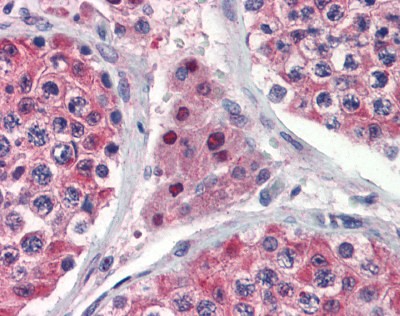
Antibody used in IHC on Human Testis at 5 ug/ml.| Product Name | IDH1 Antibody |
|---|---|
| Antibody Type | Primary Antibodies |
| Antigen Alias | IDH1, IDH, IDP, PICD, IDCD, IDPC, HEL-216, HEL-S-26 |
| Product description | Isocitrate dehydrogenases catalyze the oxidative decarboxylation of isocitrate to 2-oxoglutarate. These enzymes belong to two distinct subclasses, one of which utilizes NAD (+) as the electron acceptor and the other NADP (+).The protein encoded by this gene is the NADP (+)-dependent isocitrate dehydrogenase found in the cytoplasm and peroxisomes. It contains the PTS-1 peroxisomal targeting signal sequence. The presence of this enzyme in peroxisomes suggests roles in the regeneration of NADPH for intraperoxisomal reductions, such as the conversion of 2, 4-dienoyl-CoAs to 3-enoyl-CoAs, as well as in peroxisomal reactions that consume 2-oxoglutarate, namely the alpha-hydroxylation of phytanic acid. The cytoplasmic enzyme serves a significant role in cytoplasmic NADPH production.Isocitrate dehydrogenases catalyze the oxidative decarboxylation of isocitrate to 2-oxoglutarate. These enzymes belong to two distinct subclasses, one of which utilizes NAD (+) as the electron acceptor and the other NADP (+). Five isocitrate dehydrogenases have been reported: three NAD (+)-dependent isocitrate dehydrogenases, which localize to the mitochondrial matrix, and two NADP (+)-dependent isocitrate dehydrogenases, one of which is mitochondrial and the other predominantly cytosolic. Each NADP (+)-dependent isozyme is a homodimer. The protein encoded by this gene is the NADP (+)-dependent isocitrate dehydrogenase found in the cytoplasm and peroxisomes. It contains the PTS-1 peroxisomal targeting signal sequence. The presence of this enzyme in peroxisomes suggests roles in the regeneration of NADPH for intraperoxisomal reductions, such as the conversion of 2, 4-dienoyl-CoAs to 3-enoyl-CoAs, as well as in peroxisomal reactions that consume 2-oxoglutarate, namely the alpha-hydroxylation of phytanic acid. The cytoplasmic enzyme serves a significant role in cytoplasmic NADPH production. Publication Note: This RefSeq record includes a subset of the publications that are available for this gene. Please see the Entrez Gene record to access additional publications.1) Kullberg, M., (2006) Mol. Biol. Evol. 23 (8), 1493-1503. |
| Immunogen | Antibody produced in rabbits immunized with a synthetic peptide corresponding a region of human IDH1. |
| Clonality | Polyclonal |
|---|---|
| Host Species | Rabbit |
| Tested Applications | WB |
| IDH1 antibody can be used for detection of IDH1 by ELISA at 1:1562500. IDH1 antibody can be used for detection of IDH1 by western blot at 1 μg/mL, and HRP conjugated secondary antibody should be diluted 1:50,000 - 100,000.: |
|
| Species Reactivity | Human |
| Concentration | 1mg/ml |
| Purification | Affinity purified |
| Gene Symbol | IDH1 |
|---|---|
| Alternative Names | IDH1 IDH IDP PICD IDCD IDPC HEL-216 HEL-S-26 |
| Molecular Weight(MW) | 47 kDa |
Application
Antibody used in IHC on Human Testis at 5 ug/ml.| Positive Control | 1) 721_B Cell Lysate |
|---|---|
| Application Notes | IDH1 antibody can be used for detection of IDH1 by ELISA at 1:1562500. IDH1 antibody can be used for detection of IDH1 by western blot at 1 μg/mL, and HRP conjugated secondary antibody should be diluted 1:50,000 - 100,000.: |
| Form | Liquid |
|---|---|
| Storage Instructions | For short periods of storage (days) store at 4˚C. For longer periods of storage, store IDH1 antibody at -20˚C. As with any antibody avoid repeat freeze-thaw cycles. |
| Storage Buffer | Antibody is lyophilized in PBS buffer with 2% sucrose. Add 50 μL of distilled water. Final antibody concentration is 1 mg/mL. |


