Application
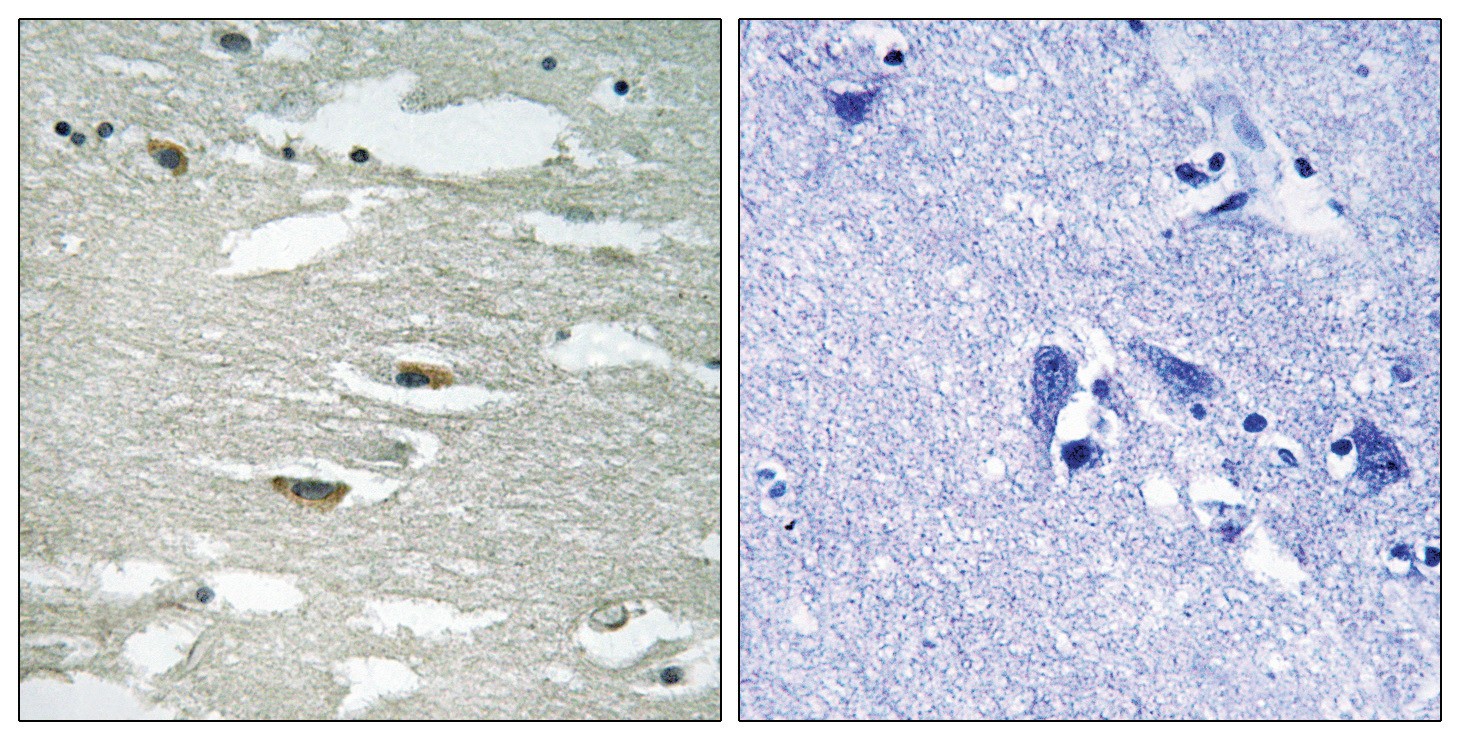
Immunohistochemical analysis of paraffin-embedded human brain tissue using ILK (Phospho-Ser246) antibody (left) or the same antibody preincubated with blocking peptide (right).| Product Name | ILK (phospho Ser246) Antibody |
|---|---|
| Antibody Type | Primary Antibodies |
| Antigen Alias | ILK1, p59ILK, kinase ILK |
| Product description | Transduction of extracellular matrix signals through integrins influences intracellular and extracellular functions, and appears to require interaction of integrin cytoplasmic domains with cellular proteins. Integrin-linked kinase (ILK), interacts with the cytoplasmic domain of beta-1 integrin. This gene encodes a serine/threonine protein kinase with 4 ankyrin-like repeats, which associates with the cytoplasmic domain of beta integrins and acts as a proximal receptor kinase regulating integrin-mediated signal transduction. Multiple alternatively spliced transcript variants encoding the same protein have been found for this gene.1) Hannigan G.E., Nature 379:91-96(1996). |
| Immunogen | ILK (phospho Ser246) antibody was raised against a peptide sequence around phosphorylation site of Serine 246 (I-F-S (p)-H-P) derived from Human ILK. |
| Modification | p-Ser246 |
| Clonality | Polyclonal |
|---|---|
| Isotype | IgG |
| Host Species | Rabbit |
| Tested Applications | IHC |
| IHC:1:50~1:200 Notes:Optimal dilutions/concentrations should be determined by the researcher. |
|
| Species Reactivity | HumanMouseRat |
| Concentration | 1mg/ml |
| Purification | Affinity purified |
| Gene Symbol | ILK |
|---|---|
| Alternative Names | ILK1 p59ILK kinase ILK |
| Molecular Weight(MW) | 51 kDa |
| Tissue Specificity | The antibody detects endogenous levels of ILK only when phosphorylated at serine 246. |
| Entrez Gene | 3611 |
|---|---|
| Protein Accession | NP_001014794.1 |
Application
Immunohistochemical analysis of paraffin-embedded human brain tissue using ILK (Phospho-Ser246) antibody (left) or the same antibody preincubated with blocking peptide (right).| Application Notes | IHC:1:50~1:200 Notes:Optimal dilutions/concentrations should be determined by the researcher. |
|---|
| Form | Liquid |
|---|---|
| Storage Instructions | Store antibody at -20˚C for up to one year. |
| Storage Buffer | Antibody supplied in phosphate buffered saline (without Mg2+ and Ca2+), pH 7.4, 150mM NaCl, 0.02% sodium azide and 50% glycerol. |


