Application
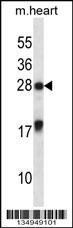
Western blot analysis in mouse heart tissue lysates (35ug/lane).Application
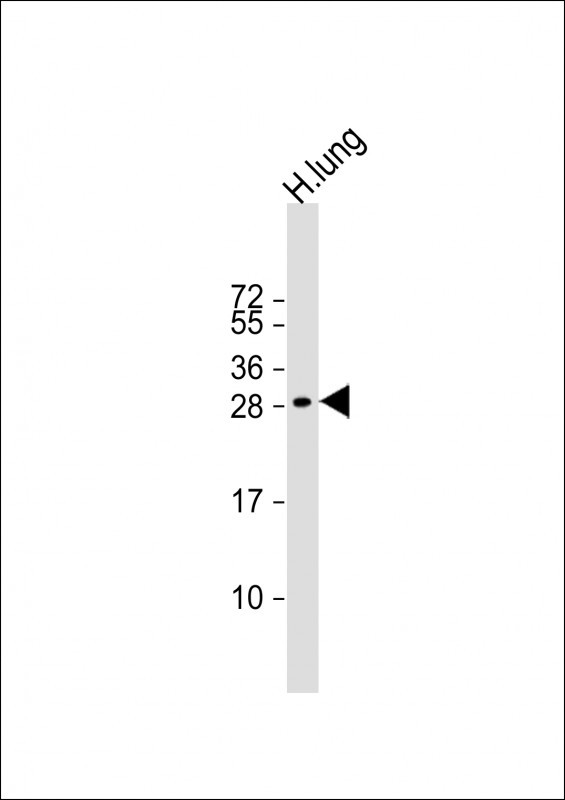
Western Blot at 1:2000 dilution + human lung lysate Lysates/proteins at 20 ug per lane.| Product Name | MXI1 Antibody |
|---|---|
| Antibody Type | Primary Antibodies |
| Product description | Expression of the c-myc gene, which produces an oncogenic transcription factor, is tightly regulated in normal cells but is frequently deregulated in human cancers. The protein encoded by this gene is a transcriptional repressor thought to negatively regulate MYC function, and is therefore a potential tumor suppressor. This protein inhibits the transcriptional activity of MYC by competing for MAX, another basic helix-loop-helix protein that binds to MYC and is required for its function. Defects in this gene are frequently found in patients with prostate tumors. Three alternatively spliced transcripts encoding different isoforms have been described. Additional alternatively spliced transcripts may exist but the products of these transcripts have not been verified experimentally.1) Lofstedt, T., et al. Exp. Cell Res. 315(11):1924-1936(2009) |
| Immunogen | This MXI1 antibody is generated from rabbits immunized with a KLH conjugated synthetic peptide between 53-82 amino acids from the Central region of human MXI1. |
| Clonality | Polyclonal |
|---|---|
| Isotype | Ig |
| Host Species | Rabbit |
| Tested Applications | WB |
| For WB starting dilution is: 1:1000 | |
| Species Reactivity | HumanMouse |
| Concentration | 1mg/ml |
| Purification | Affinity purified |
| Gene Symbol | MXI1 |
|---|---|
| Alternative Names | Max-interacting protein 1 Max interactor 1 Class C basic helix-loop-helix protein 11 bHLHc11 MXI1 BHLHC11 |
| Molecular Weight(MW) | 26 kDa |
| Sequence Similarities | Predicted species reactivity based on immunogen sequence: Rat |
Application
Western blot analysis in mouse heart tissue lysates (35ug/lane).
Application
Western Blot at 1:2000 dilution + human lung lysate Lysates/proteins at 20 ug per lane.| Application Notes | For WB starting dilution is: 1:1000 |
|---|
| Form | Liquid |
|---|---|
| Storage Instructions | Store at 4˚C for three months and -20˚C, stable for up to one year. As with all antibodies care should be taken to avoid repeated freeze thaw cycles. Antibodies should not be exposed to prolonged high temperatures. |
| Storage Buffer | Supplied in PBS with 0.09% (W/V) sodium azide. |


