Application
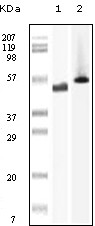
Western blot analysis using PTK6 monoclonal antibody against truncated PTK6 recombinant protein and MCF - 7 cell lysate.| Product Name | PTK6 Antibody |
|---|---|
| Antibody Type | Primary Antibodies |
| Antigen Alias | BRK, Breast tumor kinaseBRK |
| Product description | PTK6 (protein tyrosine kinase 6, BRK or FLJ42088),with 451-amino acid protein (about 51 kDa), encods a cytoplasmic nonreceptor protein kinase which may function as an intracellular signal transducer in epithelial tissues. Its presence in the nucleus appears to be linked to suppression of tumor progression. The encoded protein has been shown to undergo autophosphory-lation. Very high level in colon and high levels in small intestine and prostate, and low levels in some fetal tissues. And Expressed at low level in some breast tumors, but not in normal breast. Also found in melanocytes, but not expressed in heart, brain, placenta, lung, liver, skeletal muscle, kidney and pancreas. Overexpression of this gene in mammary epithelial cells leads to sensitization of the cells to epidermal growth factor and results in a partially transformed phenotype.1) Wilks, A.F. Proc. Natl. Acad. Sci. USA 86: 1603-1607. |
| Immunogen | Ni-NTA purified truncated recombinant PTK6 expressed in E. Coli strain BL21 (DE3). |
| Clonality | Monoclonal |
|---|---|
| Isotype | IgG2b |
| Host Species | Mouse |
| Tested Applications | ELISA |
| ELISA:Propose dilution 1:10,000. Determining optimal working dilutions by titration test.: |
|
| Species Reactivity | Human |
| Concentration | 1mg/ml |
| Gene Symbol | PTK6 |
|---|---|
| Alternative Names | BRK Breast tumor kinaseBRK |
Application
Western blot analysis using PTK6 monoclonal antibody against truncated PTK6 recombinant protein and MCF - 7 cell lysate.| Positive Control | 1) Cat. No. 1219 - MCF7 Cell Lysate |
|---|---|
| Application Notes | ELISA:Propose dilution 1:10,000. Determining optimal working dilutions by titration test.: |
| Form | Liquid |
|---|---|
| Storage Instructions | PTK6 monoclonal antibody can be stored at -20˚C, stable for one year. As with all antibodies care should be taken to avoid repeated freeze thaw cycles. Antibodies should not be exposed to prolonged high temperatures. |
| Storage Buffer | Ascitic fluid containing 0.03% sodium azide. |


