Application
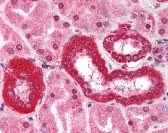
Immunohistochemistry staining of RAD52 in kidney tissue using RAD52 monoclonal Antibody.| Product Name | RAD52 Antibody [5H9] |
|---|---|
| Antibody Type | Primary Antibodies |
| Product description | DNA double-strand breaks can be generated by exposure to ionizing radiation or through endogenous cellular reactions. Double-strand breaks are generally thought to be repaired via one of two distinct mechanisms: homologous recombination (HR) or non-homologous end joining (NHEJ). Homologous recombination requires the activity of the members of the RAD52 epistasis group, which includeRAD50, RAD51, RAD52, RAD54, RDH54/TID1, RAD55, RAD57, RAD59, MRE11, and XRS2. RAD52 can catalyze strand annealing reactions, and can form oligomers that attach to ends of single-stranded DNA. |
| Immunogen | RAD52 monoclonal antibody was raised against recombinant RAD52 (Human). |
| Clonality | Monoclonal |
|---|---|
| Isotype | IgG |
| Host Species | Mouse |
| Tested Applications | WB |
| RAD52 antibody can be used in ELISA, Western Blot starting at 1:500 - 1:1000, and immunohistochemistry starting at 5 μg/mL. | |
| Species Reactivity | Human |
| Concentration | 1mg/ml |
| Purification | Protein G |
| Gene Symbol | RAD52 |
|---|---|
| Alternative Names | RAD52 RAD52 (S. cerevisiae) homolog RAD52 homolog (S. cerevisiae) Recombination protein RAD52 |
Application
Immunohistochemistry staining of RAD52 in kidney tissue using RAD52 monoclonal Antibody.| Application Notes | RAD52 antibody can be used in ELISA, Western Blot starting at 1:500 - 1:1000, and immunohistochemistry starting at 5 μg/mL. |
|---|
| Form | Liquid |
|---|---|
| Storage Instructions | Store RAD52 antibody at -20 ˚C. As with all antibodies avoid freeze/thaw cycles. |
| Storage Buffer | PBS, pH 7.2, Contains no preservative. |


