Application
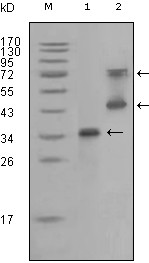
Western blot analysis using RET monoclonal antibody against truncated RET - GST recombinant protein and STYK1 (aa658 - 1063) / hIgGFc transfected CHO - K1 cell lysate.| Product Name | RET Antibody |
|---|---|
| Antibody Type | Primary Antibodies |
| Antigen Alias | CDHF12, CDHR16, PTC, RET51, Cadherin family member 12PTC, MTC1, HSCR1, MEN2A, MEN2B, CDHF12, RET-ELE1 |
| Product description | RET (ret proto-oncogene) is a member of the cadherin superfamily and a receptor tyrosine kinase, which are cell-surface molecules that transduce signals for cell growth and differentiation. It can undergo oncogenic activation in vivo and in vitro by cytogenetic rearrangement. Ligands that bind the Ret receptor include the glial cell line-derived neurotropic factor (GDNF) and its congeners neurturin, persephin and artemin. Alterations in the corresponding Ret gene are associated with diseases including papillary thyroid carcinoma, multiple endocrine neoplasia (type 2A and 2B), familial medullary thyroid carcinoma and a congenital developmental disorder known as Hirschsprung抯 disease. The Tyr905 residue located in the Ret kinase domain plays a crucial role in Ret catalytic and biological activity. Substitution of Phe for Tyr905 dramatically inhibits Ret autophosphorylation activity.1) Young HM. Anderson RB. Anderson CR. Auton Neurosci. 2004, May 31,112(1-2):1-14. |
| Immunogen | Purified truncated recombinant RET (aa896-1063)-GST fusion protein is expressed in E. Coli strain BL21 (DE3). |
| Clonality | Monoclonal |
|---|---|
| Isotype | IgG1 |
| Host Species | Mouse |
| Tested Applications | ELISAWB |
| Western Blot:1:500 - 1:2,000 IHC(P):1:500 - 1:2,000 ELISA:Propose dilution 1:10,000. Determining optimal working dilutions by titration test.: |
|
| Species Reactivity | Human |
| Concentration | 1mg/ml |
| Gene Symbol | RET |
|---|---|
| Alternative Names | CDHF12 CDHR16 PTC RET51 Cadherin family member 12PTC MTC1 HSCR1 MEN2A MEN2B CDHF12 RET-ELE1 |
Application
Western blot analysis using RET monoclonal antibody against truncated RET - GST recombinant protein and STYK1 (aa658 - 1063) / hIgGFc transfected CHO - K1 cell lysate.| Application Notes | Western Blot:1:500 - 1:2,000 IHC(P):1:500 - 1:2,000 ELISA:Propose dilution 1:10,000. Determining optimal working dilutions by titration test.: |
|---|
| Form | Liquid |
|---|---|
| Storage Instructions | RET monoclonal antibody can be stored at -20˚C, stable for one year. As with all antibodies care should be taken to avoid repeated freeze thaw cycles. Antibodies should not be exposed to prolonged high temperatures. |
| Storage Buffer | Ascitic fluid containing 0.03% sodium azide. |


