Application
Synaptotagmin (Phospho-Ser309) Antibody| Product Name | Synaptotagmin (phospho Ser309) Antibody |
|---|---|
| Antibody Type | Primary Antibodies |
| Antigen Alias | P65, Synaptotagmin I, SytI |
| Product description | Synaptotagmin is widely regarded as the primary calcium sensor for synaptic vesicle exocytosis. Moreover recent studies indicate that the protein also plays a key role in endocytosis. Synaptotagmin can be phosphorylated by multiple protein kinases and this may play a key role in modulation of synaptotagmin ability to influence both the exocytotic and endocytotic components of synaptic transmission.1) Poskanzer, K.E., Marek, K.W., Sweeney, S.T. and Davis, G.W., "Synaptotagmin I is necessary for compensatory synaptic vesicle endocytosis in vivo," Nature (London) 426 (2003) 559 - 563. |
| Immunogen | Synaptotagmin (Ser309) polyclonal antibody was raised against a synthetic phosphopeptide corresponding to amino acids residues surrounding the phospho Ser309 of synaptotagmin. |
| Modification | p-Ser309 |
| Clonality | Polyclonal |
|---|---|
| Host Species | Rabbit |
| Tested Applications | IHCWB |
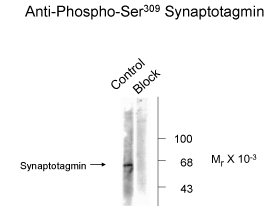
| Applications include Dot Blots (DB) and Western Blots (WB). Suitability for Immunohistochemistry (IHC) has not yet been determined. Human, mouse, and rat have 100% amino acid sequence identity with the antigen used to raise the antibody. When internally tested under ideal conditions the working dilutions were 1:1000 for DB and WB.: |
|
| Species Reactivity | HumanMouseRat |
| Concentration | 1mg/ml |
| Purification | Affinity purified |
| Gene Symbol | Syt1 |
|---|---|
| Alternative Names | P65 Synaptotagmin I SytI |
| Molecular Weight(MW) | 60/62 |
| Tissue Specificity | Synaptotagmin antibody is specific for Mr 60 - 62k synaptotagmin phosphorylated at Ser309. |
Application
Synaptotagmin (Phospho-Ser309) Antibody| Application Notes | Applications include Dot Blots (DB) and Western Blots (WB). Suitability for Immunohistochemistry (IHC) has not yet been determined. Human, mouse, and rat have 100% amino acid sequence identity with the antigen used to raise the antibody. When internally tested under ideal conditions the working dilutions were 1:1000 for DB and WB.: |
|---|
| Form | Liquid |
|---|---|
| Storage Instructions | For long term storage –80˚C is recommended, but shorter term storage at –20˚C is also acceptable as aliquots may be taken without freeze/thawing due to the presence of 50% glycerol. Stable for one year. |
| Storage Buffer | 100 uL in 10 mM HEPES (pH 7.5), 150 mM NaCl, 100 ug per mL BSA and 50% glycerol. |


