Application
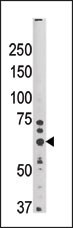
Western blot analysis of anti-HRD1 Pab in mouse brain tissue lysate (35ug/lane)| Product Name | SYVN1 Antibody |
|---|---|
| Antibody Type | Primary Antibodies |
| Product description | HRD1 is a ubiquitin ligase whose expression is induced by the unfolded protein response (UPR) following endoplasmic reticulum stress. Expression of HRD1 protects cells from apoptosis by inducing degradation of abnormally processed proteins that accumulate in the endoplasmic reticulum. HRD1 is expressed in many tissues, strongly expressed in brain, pancreas, liver, kidney and skeletal muscle. Synoviolin/Hrd1 (expressed in rheumatoid synovium) is reported to be a novel causative factor for arthropathy by triggering synovial cell outgrowth through its antiapoptotic effects. HRD1 contains one ring-type zinc finger.1) Kikkert, M., et al., J. Biol. Chem. 279(5):3525-3534 (2004). Amano, T., et al., Genes Dev. 17(19):2436-2449 (2003). Nadav, E., et al., Biochem. Biophys. Res. Commun. 303(1):91-97 (2003). Kaneko, M., et al., FEBS Lett. 532 (1-2), 147-152 (2002) (): (). |
| Immunogen | This SYVN1 (HRD1) antibody is generated from rabbits immunized with a KLH conjugated synthetic peptide between 58-88 amino acids from the N-terminal region of human SYVN1 (HRD1). |
| Clonality | Polyclonal |
|---|---|
| Isotype | Ig |
| Host Species | Rabbit |
| Tested Applications | WB |
| For WB starting dilution is: 1:1000 | |
| Species Reactivity | Human |
| Concentration | 1mg/ml |
| Purification | Unpurified |
| Gene Symbol | SYVN1 |
|---|---|
| Alternative Names | E3 ubiquitin-protein ligase synoviolin 632- Synovial apoptosis inhibitor 1 SYVN1 HRD1 KIAA1810 |
| Molecular Weight(MW) | 68 kDa |
| Sequence Similarities | Predicted species reactivity based on immunogen sequence: Mouse |
Application
Western blot analysis of anti-HRD1 Pab in mouse brain tissue lysate (35ug/lane)| Application Notes | For WB starting dilution is: 1:1000 |
|---|
| Form | Liquid |
|---|---|
| Storage Instructions | Store at 4˚C for three months and -20˚C, stable for up to one year. As with all antibodies care should be taken to avoid repeated freeze thaw cycles. Antibodies should not be exposed to prolonged high temperatures. |
| Storage Buffer | Supplied in PBS with 0.09% (W/V) sodium azide. |


