Application
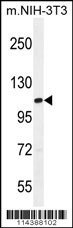
Western blot analysis in mouse NIH-3T3 cell line lysates (35ug/lane).| Product Name | TAF1 Antibody |
|---|---|
| Antibody Type | Primary Antibodies |
| Antigen Alias | Transcription initiation factor TFIID subunit 1, Cell cycle gene 1 protein, TBP-associated factor 250 kDa, p250, Transcription initiation factor TFIID 250 kDa subunit, TAF(II)250, TAFII-250, TAFII250, TAF1, BA2R, CCG1, CCGS, TAF2A |
| Product description | Initiation of transcription by RNA polymerase II requires the activities of more than 70 polypeptides. The protein that coordinates these activities is the basal transcription factor TFIID, which binds to the core promoter to position the polymerase properly, serves as the scaffold for assembly of the remainder of the transcription complex, and acts as a channel for regulatory signals. TFIID is composed of the TATA-binding protein (TBP) and a group of evolutionarily conserved proteins known as TBP-associated factors or TAFs. TAFs may participate in basal transcription, serve as coactivators, function in promoter recognition or modify general transcription factors (GTFs) to facilitate complex assembly and transcription initiation. This gene encodes the largest subunit of TFIID. This subunit binds to core promoter sequences encompassing the transcription start site. It also binds to activators and other transcriptional regulators, and these interactions affect the rate of transcription initiation. This subunit contains two independent protein kinase domains at the N and C-terminals, but also possesses acetyltransferase activity and can act as a ubiquitin-activating/conjugating enzyme. This gene is part of a complex transcriptional unit (TAF1/DYT3), wherein some products share exons with TAF1 as well as additional exons downstream.1) Tavassoli, P., et al. Mol. Endocrinol. 24(4):696-708(2010) |
| Immunogen | This TAF1 antibody is generated from rabbits immunized with a KLH conjugated synthetic peptide between 1863-1893 amino acids from the C-terminal region of human TAF1. |
| Clonality | Polyclonal |
|---|---|
| Isotype | Ig |
| Host Species | Rabbit |
| Tested Applications | WB |
| For WB starting dilution is: 1:1000: |
|
| Species Reactivity | Mouse |
| Concentration | 1mg/ml |
| Purification | Affinity purified |
| Gene Symbol | TAF1 |
|---|---|
| Alternative Names | Transcription initiation factor TFIID subunit 1 Cell cycle gene 1 protein TBP-associated factor 250 kDa p250 Transcription initiation factor TFIID 250 kDa subunit TAF(II)250 TAFII-250 TAFII250 TAF1 BA2R CCG1 CCGS TAF2A |
| Molecular Weight(MW) | 213 kDa |
Application
Western blot analysis in mouse NIH-3T3 cell line lysates (35ug/lane).| Application Notes | For WB starting dilution is: 1:1000: |
|---|
| Form | Liquid |
|---|---|
| Storage Instructions | Store at 4˚C for three months and -20˚C, stable for up to one year. As with all antibodies care should be taken to avoid repeated freeze thaw cycles. Antibodies should not be exposed to prolonged high temperatures. |
| Storage Buffer | Supplied in PBS with 0.09% (W/V) sodium azide. |


