Application
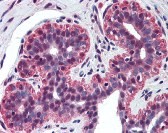
Immunohistochemistry staining of TP73 in breast tissue using TP73 monoclonal Antibody.| Product Name | TP73 Antibody |
|---|---|
| Antibody Type | Primary Antibodies |
| Antigen Alias | TP73, p53-like transcription factor, p73, p53-related protein, Tumor protein p73 |
| Product description | p73 was identified as a long-lost cousin of tumor suppressor protein, p53. p73 has high homology with p53 as well as with p63, a gene implicated in the maintenance of epithelial stem cells. Significant homology between p53, p63, and p73 (approximately 63% amino acid identity in the DNA-binding domain suggest that they may have overlapping functions in the regulation of gene expression. The targeted disruption of p73 gene leads to defects hippocampal dysgenesis, hydrocephalus, chronic inflammation and infections. Recently, spilicing variant mRNAs of p73 has been identified in MCF-7, a breast carcinoma cell line. These mRNAs code for variant p73 proteins bearing distinct carboxy-terminal structures suggesting that the carboxy-terminal region of p73 may be important for the functions of this protein. Tumor BioMarker: Vella et al (2003) found p73 to be upregulated in a significant fraction of anaplastic thyroid cancers, whereas it was not detectable in normal thyroid epithelial cells nor in papillary or follicular thyroid cancer. |
| Immunogen | Full-length human p73. |
| Clonality | Monoclonal |
|---|---|
| Isotype | IgG |
| Host Species | Mouse |
| Tested Applications | ICCIHCIPWB |
| TP73 antibody can be used in ELISA, and immunohistochemistry starting at 10 μg/mL.: |
|
| Species Reactivity | HumanMouse |
| Concentration | 1mg/ml |
| Purification | Protein G |
| Gene Symbol | TP73 |
|---|---|
| Alternative Names | TP73 p53-like transcription factor p73 p53-related protein Tumor protein p73 |
| Tissue Specificity | Recognizes all of the TAp73 isoforms i. e. isoforms with an intact NH2-terminal transactivation domain (Thottassery et el, 2006, PMID 16505115). Sayan et al 2005 (PMID 15781249) showed that p73 IMG-246/ NBP2-24737 reacted with all tested TAp73 isofor ... |
Application
Immunohistochemistry staining of TP73 in breast tissue using TP73 monoclonal Antibody.| Application Notes | TP73 antibody can be used in ELISA, and immunohistochemistry starting at 10 μg/mL.: |
|---|
| Form | Liquid |
|---|---|
| Storage Instructions | TP73 antibody can be stored short term 4 ˚C. For long term storage aliquot and store at -20 ˚C. As with all antibodies avoid freeze/thaw cycles. |
| Storage Buffer | PBS containing 0.05% BSA and 0.05% sodium azide |


