
Application
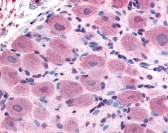
Immunohistochemistry staining of TRPA1 in spinal cord, drg tissue using TRPA1 Antibody.IF
b Immunofluorescence staining of TRPA1 in OLN-93 oligodendrocyte. DAPI (blue), MBP-AF594 (red), and TRPA1-AF488 (green) are shown.| Product Name | TRPA1 Antibody |
|---|---|
| Antibody Type | Primary Antibodies |
| Product description | TRPA1 has been suggested to be a cold-activated ion channel. It has also been suggested to affect mechanotransduction and the perception of sound in vertebrates. |
| Immunogen | TRPA1 antibody was raised against a peptide located near the internal domain of TRPA1 (Human). |
| Clonality | Polyclonal |
|---|---|
| Host Species | Rabbit |
| Tested Applications | ICC/IFWB |
| Immunohistochemistry: validated for use in immunohistochemistry on a panel of 21 formalin-fixed, paraffin-embedded (FFPE) human tissues after heat induced antigen retrieval in pH 6.0 citrate buffer. After incubation with the primary antibody, slides were incubated with biotinylated secondary antibody, followed by alkaline phosphatase-streptavidin and chromogen. The stained slides were evaluated by a pathologist to confirm staining specificity. The optimal working concentration was determined to be 10-20 ug/ml.: |
|
| Species Reactivity | Human |
| Concentration | 1mg/ml |
| Purification | Affinity purified |
| Gene Symbol | TRPA1 |
|---|---|
| Alternative Names | TRPA1 ANKTM1 TRPA-1 |
| Tissue Specificity | BLAST analysis of the peptide immunogen showed no homology with other human proteins. |
Application
Immunohistochemistry staining of TRPA1 in spinal cord, drg tissue using TRPA1 Antibody.
IF
b Immunofluorescence staining of TRPA1 in OLN-93 oligodendrocyte. DAPI (blue), MBP-AF594 (red), and TRPA1-AF488 (green) are shown.| Application Notes | Immunohistochemistry: validated for use in immunohistochemistry on a panel of 21 formalin-fixed, paraffin-embedded (FFPE) human tissues after heat induced antigen retrieval in pH 6.0 citrate buffer. After incubation with the primary antibody, slides were incubated with biotinylated secondary antibody, followed by alkaline phosphatase-streptavidin and chromogen. The stained slides were evaluated by a pathologist to confirm staining specificity. The optimal working concentration was determined to be 10-20 ug/ml.: |
|---|
| Form | Liquid |
|---|---|
| Storage Instructions | TRPA1 antibody should be stored long term (months) at -80 ˚C and short term (days) at 4 ˚C. As with all antibodies avoid freeze/thaw cycles. |
| Storage Buffer | PBS, 0.1% sodium azide. |


