Application
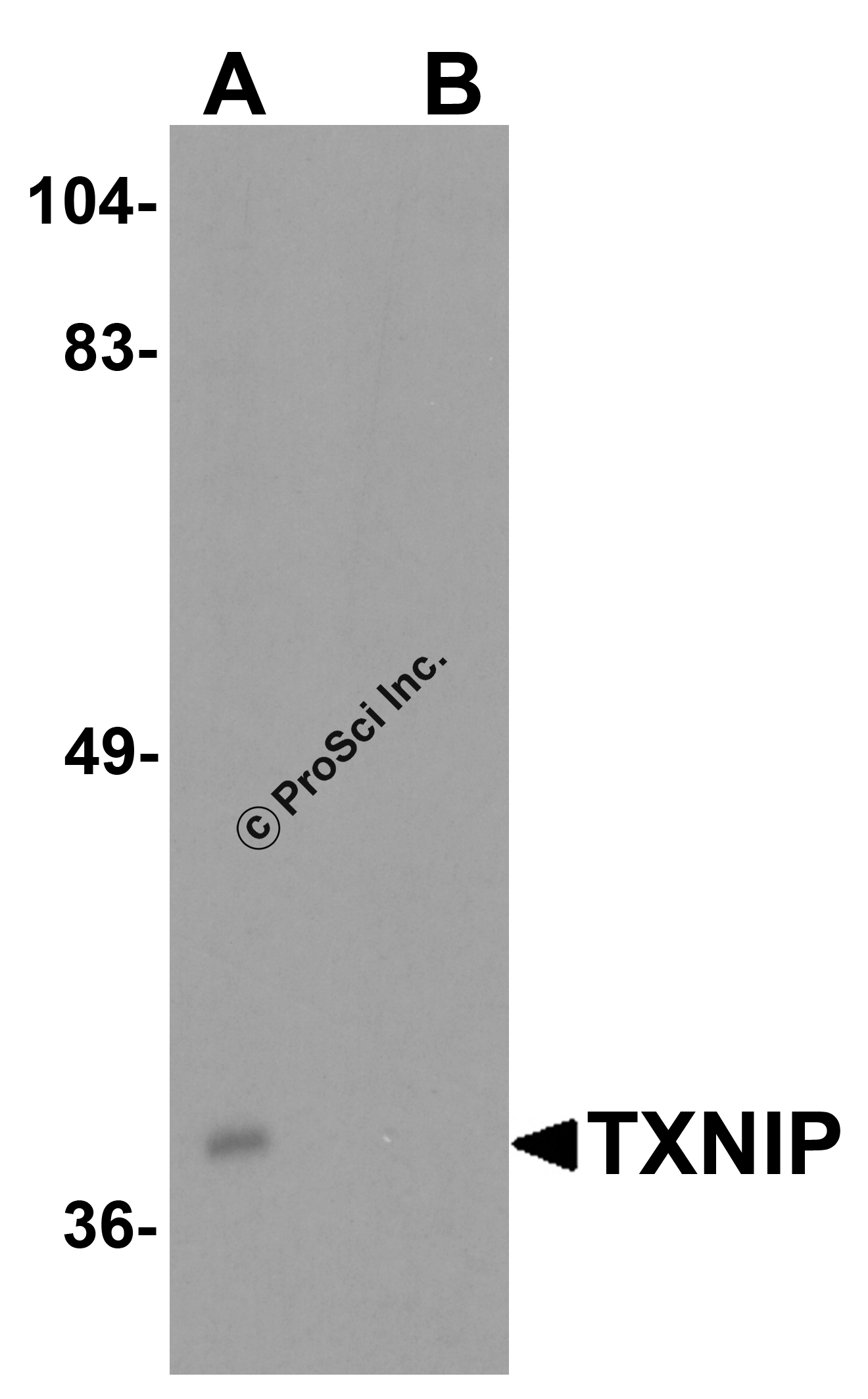
Western blot analysis of TXNIP in C2C12 cell lysate with TXNIP antibody at 0.5 μg/ml in (A) the absence and (B) the presence of blocking peptide.| Product Name | TXNIP Antibody |
|---|---|
| Antibody Type | Primary Antibodies |
| Antigen Alias | Thioredoxin-interacting protein, BMP and activin membrane-bound inhibitor homolog, non-metastatic gene A protein, NMA |
| Product description | Thioredoxin-interacting protein (TXNIP) belongs to the arrestin family and plays a critical role in the antioxidant defense mechanisms of hematopoietic cells by activating the p53 pathway during oxidative stress (1,2). It functions as a transcriptional repressor and acts as an oxidative stress mediator by inhibiting thioredoxin activity (2). TXNIP expression is reduced in many types of tumors, and TXNIP overexpression inhibits tumor growth by blocking cell-cycle progression (3). It has recently reported that TXNIP deficiency correlates with a high incidence of hepatocellular carcinoma (HCC) (4). TXNIP and p53 interactions could potentially be a therapeutic target for oxidative stress-related diseases such as hematopoietic malignancies and metabolic diseases (5).1) Chen KS and DeLuca HF. Isolation and characterization of a novel cDNA from HL-60 cells treated with 1, 25-dihydroxyvitamin D-3. Biochim. Biophys. Acta. 1994; 1219:26-32. |
| Immunogen | TXNIP antibody was raised against a 16 amino acid peptide near the center of human TXNIP. The immunogen is located within amino acids 110 - 160 of TXNIP. |
| Clonality | Polyclonal |
|---|---|
| Isotype | IgG |
| Host Species | Rabbit |
| Tested Applications | ELISAWB |
| TXNIP body can be used for detection of TXNIP by Western blot at 0.5 - 1 μg/ml.: |
|
| Species Reactivity | HumanMouseRat |
| Concentration | 1mg/ml |
| Purification | Affinity purified |
| Gene Symbol | TXNIP |
|---|---|
| Alternative Names | Thioredoxin-interacting protein BMP and activin membrane-bound inhibitor homolog non-metastatic gene A protein NMA |
| Molecular Weight(MW) | Predicted: 43 kDa Observed: 39 kDa |
| Sequence Similarities | Predicted species reactivity based on immunogen sequence: Pig: (94%) |
| Tissue Specificity | TXNIP antibody is human, mouse and rat reactive. |
Application
Western blot analysis of TXNIP in C2C12 cell lysate with TXNIP antibody at 0.5 μg/ml in (A) the absence and (B) the presence of blocking peptide.| Positive Control | 1) Cat. No. 1285 - C2C12 Cell Lysate |
|---|---|
| Application Notes | TXNIP body can be used for detection of TXNIP by Western blot at 0.5 - 1 μg/ml.: |
| Form | Liquid |
|---|---|
| Storage Instructions | TXNIP antibody can be stored at 4˚C for three months and -20˚C, stable for up to one year. |
| Storage Buffer | TXNIP antibody is supplied in PBS containing 0.02% sodium azide. |


